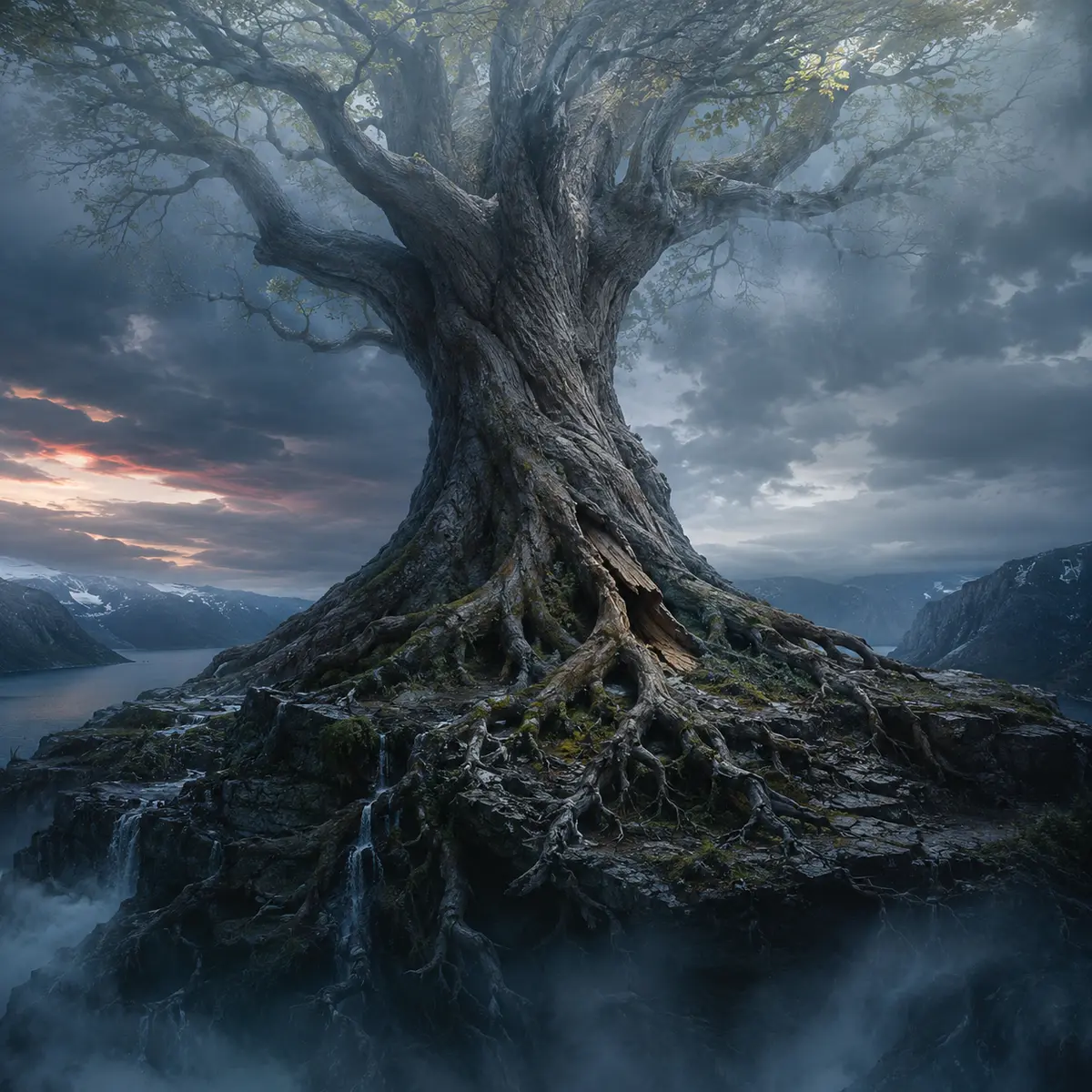
Yggdrasil is one of the most powerful images in Norse mythology: a vast tree whose roots and branches reach through the mythic cosmos. Modern posters often turn it into a precise diagram of nine separate realms. The medieval sources give us something more fluid, poetic and internally varied.
The Tree That Holds the World
In the Poetic Edda and Snorri Sturluson's Prose Edda, Yggdrasil is the great tree associated with the structure and continuing life of the cosmos. It is commonly described as an ash, although mythic descriptions do not function like a modern botanical report.
The gods travel to the tree for their assembly. Roots extend toward powerful wells and regions associated with gods, giants and the dead. Animals feed on or move through the tree, while water and care preserve it.
Yggdrasil is therefore not merely a road connecting separate planets. It represents relationship: upper and lower, centre and outside, order and danger, growth and decay.
Yggdrasil is a living structure under pressure—not a static fantasy map.
Midgard: The Enclosure in the Middle
Midgard means the enclosure in the middle. It is the ordered space inhabited by humans and protected from the dangerous outside, especially the regions associated with giants.
This image reflects lived experience. Scandinavian farms and settled districts were surrounded by uncultivated land, forest, mountains and water. The mythic opposition between an inhabited centre and a threatening outside could therefore be understood through everyday landscape.
Midgard should not automatically be pictured as a modern planet floating in space. The sources often express location through enclosure, direction, distance, boundaries and movement.
The Problem of the Nine Worlds
The number nine appears repeatedly in Norse myth. Völuspá refers to nine worlds remembered by the seeress, and other texts also use the expression. Yet no surviving source presents one complete, numbered list of all nine worlds.
The familiar modern set—Asgard, Vanaheim, Midgard, Jotunheim, Alfheim, Svartalfheim or Nidavellir, Muspelheim, Niflheim and Hel—is a useful synthesis assembled from names found across different passages.
Uncertainty remains because some names may overlap, some describe regions within larger spaces, and the sources do not always place them consistently. Hel, for example, can refer to a being, a destination of the dead and a realm; Niflheim and Niflhel are not handled identically in every reconstruction.
The statement that Norse mythology contains nine worlds is grounded in the texts. A perfectly labelled chart showing their exact arrangement is modern interpretation.
Roots, Wells and Beings
Snorri describes three great roots extending toward different regions and associates them with Urðarbrunnr, Mímisbrunnr and Hvergelmir. The norns care for the tree near Urðarbrunnr, while Mímir's well is connected with wisdom.
Níðhöggr gnaws below, an eagle occupies the upper tree, and the squirrel Ratatoskr carries hostile messages between them. Stags feed among the branches. These beings make the cosmos active and unstable rather than perfectly balanced.
Details vary between poems and Snorri's synthesis. We should resist forcing every description into one literal three-dimensional model.
Growth, Decay and Renewal
Yggdrasil is majestic, but it is not untouched. Creatures consume its leaves and roots, its sides suffer decay, and the tree trembles during Ragnarök.
At the same time, it is continually sustained. Water and protective care maintain it, and the wider mythic cycle leads through destruction toward renewal.
This tension gives Yggdrasil much of its meaning. Life persists not because nothing attacks it, but because connection and renewal continue under pressure.
Poetry, Prose and Reconstruction
The Poetic Edda preserves mythic poems in manuscripts written after the Viking Age, although some material may be considerably older. Their language is compressed, allusive and not designed as an encyclopedia.
Snorri's thirteenth-century Prose Edda organises many traditions for readers learning skaldic poetry. It is indispensable, but it is also a medieval Christian author's synthesis of earlier material.
Scholars compare poems, prose, place-names, images and archaeological contexts. The result is not one final blueprint. Research has shown that apparent contradictions may reflect different perspectives, regional traditions or ways of describing movement between worlds.
Modern Yggdrasil: Art, Games and Paganism
Contemporary artists, games and films often depict nine circular realms attached to the branches of a cosmic tree. This is effective visual storytelling, but it should be labelled as a modern design solution.
Modern Norse pagan traditions may also use Yggdrasil as a symbol of interconnection, ancestry, ecology or spiritual growth. These are meaningful contemporary interpretations, not proof of one unchanged Viking Age doctrine.
Responsible design does not require abandoning imagination. It requires saying where the historical evidence ends and artistic creation begins.
Summary
Yggdrasil expresses a living cosmos built from relationships, boundaries and movement. It joins divine, human, giant and dead worlds while enduring constant damage and renewal.
The sources refer to nine worlds but do not preserve a definitive list or map. Every clean modern diagram is therefore a reconstruction—and should be presented as one.
Source trail