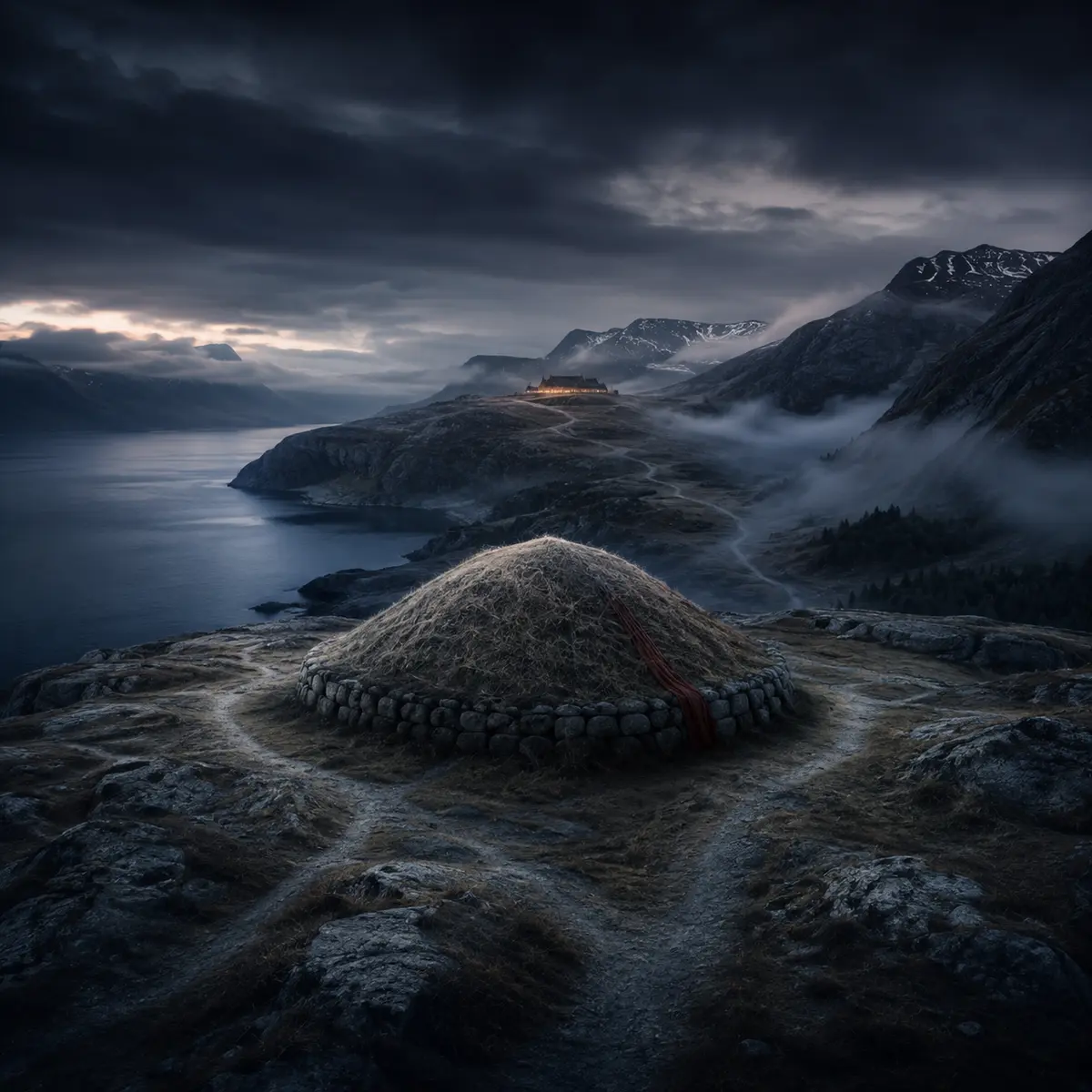
Popular culture treats Valhalla as the automatic destination of every brave Viking. The surviving myths are more selective, while archaeology reveals a striking variety of funerals without telling us exactly where each community believed the dead would go.
There Was No Single Norse Afterlife
Old Norse texts describe more than one destination for the dead. A person's fate could be connected with the manner of death, divine selection, social identity, local tradition and the needs of a particular story.
Valhalla, Fólkvangr and Hel are the best-known names, but they do not form a tidy universal system. Later literature also imagines the dead remaining close to burial mounds, mountains, farms and descendants.
The evidence is uneven. Most detailed mythic descriptions survive in medieval Icelandic manuscripts written after conversion to Christianity, while burial archaeology shows what the living did with bodies and objects rather than the destination they imagined for a soul.
A grave records what the living did. It does not name the world the dead entered.
Valhöll: Odin's Hall of the Slain
Valhöll, commonly anglicised as Valhalla, means the hall of the slain. In the mythic sources, Odin receives selected people killed in battle. Valkyries participate in choosing the slain, and the dead warriors become the einherjar.
The einherjar fight, feast and prepare for Ragnarök, when they will support Odin against the forces threatening the gods. Valhalla is therefore a specialised warrior hall, not a general Norse version of heaven.
Its prominence in skaldic and Eddic poetry may reflect the interests of warrior elites and poets. It does not prove that every Scandinavian community treated Odin's hall as the central hope of every person.
Fólkvangr and Freyja's Share
The poem Grímnismál states that Freyja chooses half of those slain in battle, while Odin receives the other half. Freyja's realm is called Fólkvangr, and her hall there is Sessrúmnir.
This alone breaks the modern formula that all honoured battle-dead belonged to Odin. It also reflects Freyja's connection with warfare and death alongside fertility, desire and seiðr.
The surviving descriptions of Fólkvangr are much briefer than those of Valhalla. Modern art often fills those gaps, but invented details should not be presented as preserved Viking Age doctrine.
Hel Was Not the Christian Hell
Hel can name both a female ruler of the dead and the realm associated with her. Later Norse texts often connect this destination with people who did not die in battle, although the traditions are not perfectly consistent.
The English word hell is historically related to the Germanic name, but that does not make the Norse Hel identical to the Christian place of eternal moral punishment. The realm can be cold, distant and gloomy, yet it is not described simply as a prison for everyone judged evil.
Some texts contain places of punishment for particular wrongdoers, but combining every underworld image into one Christian-style hell removes important distinctions between the traditions.
The Dead Close to Mounds and Landscape
Later sagas and poetry sometimes portray the dead as present within a burial mound or connected with a mountain, farm and family line. Ancestors could remain socially important rather than disappearing into one remote realm.
Burial monuments made this relationship visible. Mounds and stone settings occupied the landscape, could receive later burials and were revisited or reused by the living.
These traditions do not give us one universal model of ancestor belief. They do show why the Norse afterlife should be imagined as a group of overlapping possibilities rather than a single road.
What Burials Can—and Cannot—Tell Us
Viking Age funerary practice varied by time, place and status. Many people were cremated, while others were buried without burning. Remains could be placed in vessels, beneath stone settings, in mounds, chambers, coffins or boats.
Food, animals, tools, jewellery, weapons and vessels might accompany the dead. Such choices reveal ritual action, resources and relationships among the living, but a weapon does not automatically prove that its owner expected Valhalla.
The famous image of a burning ship pushed onto the sea is not a standard archaeological template. Boat and ship burials existed, and cremation existed, but funerary practices should not be collapsed into one cinematic scene.
Sources, Reconstruction and Pop Culture
The Poetic Edda preserves essential poems in later manuscripts, and Snorri Sturluson's Prose Edda organises mythic material in the thirteenth century. Both are indispensable, but neither is a Viking Age handbook recording one unchanged belief system.
Archaeology supplies graves, bones, objects and landscapes. It can test or complicate literary pictures, yet it cannot identify a named afterlife from grave goods alone.
Modern games, television and fashion often turn Valhalla into a reward for courage. That is effective storytelling and identity art, provided it is labelled as modern interpretation rather than direct historical reconstruction.
Summary
Valhalla was Odin's hall for selected battle-dead, not the automatic destination of every Viking. Freyja received part of the slain in Fólkvangr, Hel represented another realm, and some traditions kept the dead connected to mounds, ancestors and landscape.
Funeral archaeology reveals diverse ways of treating the dead but cannot assign each grave to a mythic destination. The most accurate conclusion is not one fixed map, but several overlapping ideas preserved through different kinds of evidence.
Source trail