Modern summaries often turn the Norse gods into a clean chart: Odin rules war and wisdom, Thor controls thunder, and Freyja represents love. The surviving traditions are much less orderly. Gods act across several domains, share powers and form relationships that cannot be reduced to one-word labels.
Not a Tidy Pantheon
The word pantheon is convenient, but it can suggest a fixed organisation that the evidence does not support. Old Norse religion had no central institution defining one official hierarchy for every Scandinavian community.
The gods appear through poems, stories, place-names, personal names, images, amulets and other archaeological finds. These sources were created in different places and periods, so they do not preserve one complete and internally consistent system.
A god important to an aristocratic poet was not necessarily approached in the same way by a farming household. Regional traditions and personal relationships mattered.
The Norse gods formed a network of relationships—not a list of supernatural job titles.
Æsir and Vanir
Later Old Norse texts distinguish two named groups of gods. The Æsir include figures such as Odin, Thor, Frigg and Baldr. The Vanir are represented most clearly by Njord, Freyr and Freyja.
A mythic war between the two groups ends in peace and an exchange of hostages. Njord, Freyr and Freyja consequently live among the Æsir, making the boundary between the groups less rigid than a simple opposition suggests.
The Vanir are often described as gods of fertility and prosperity, while the Æsir are associated with rule, war and social order. This can be a useful introduction, but their functions overlap. Freyja is linked with fertility, desire, seiðr, warfare and the dead; Odin is linked with rulership, war, death, poetry, knowledge and magic.
Odin: Knowledge, War, Poetry and Death
Odin is frequently called the foremost of the Æsir in the surviving literary tradition. He has many names and appears as a seeker of knowledge, a giver of poetic inspiration, a practitioner of magic and a power connected with rulers, battle and the dead.
This complexity matters. Odin is not simply a modern father figure or an honourable warrior-god. In the myths he uses disguise, deception, sacrifice and dangerous knowledge to achieve his aims.
His prominence in surviving aristocratic poetry does not prove that he was the favourite god of every Scandinavian. The documentary record gives some divine figures much clearer literary voices than others.
Thor: Protection, Strength and Cosmic Order
Thor fights giants and other forces that threaten the ordered world of gods and humans. Thunder and physical strength belong to his image, but protection and the maintenance of order are equally important.
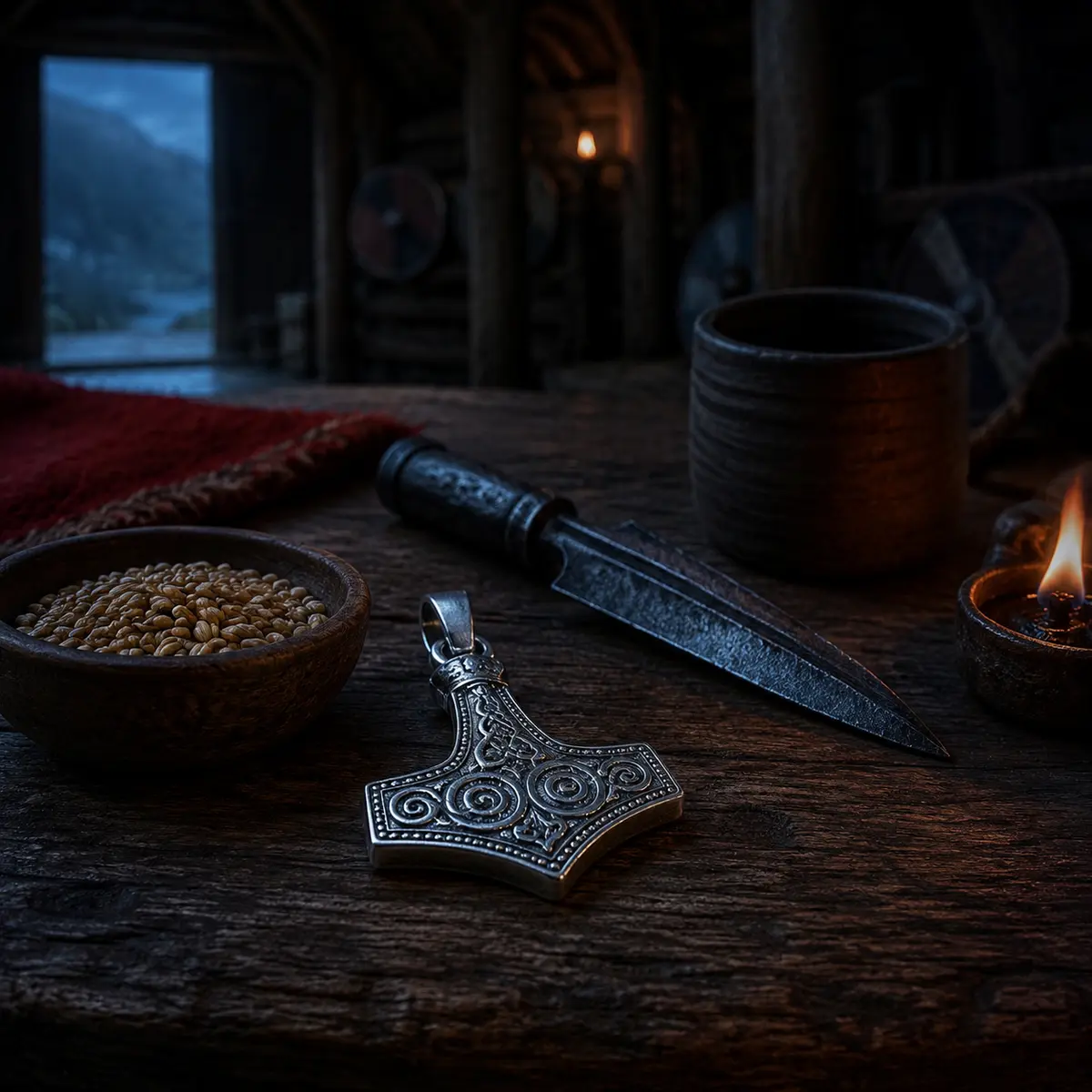
Hammer-shaped pendants and hammer motifs provide material evidence for Thor's significance during the Viking Age. Finds do not reveal the private thoughts of every wearer, yet their distribution shows that Mjölnir was more than a literary invention recorded after conversion.
Thor's hammer also appears in stories as an object used to hallow or bless. It should therefore not be reduced to a weapon or a modern emblem of aggression.
Freyja: Desire, Fertility, Seiðr and War
Freyja belongs to the Vanir and is associated with sexuality, desire, fertility and precious wealth. She is also connected with seiðr, a form of magic, and with those who die in battle.
In later texts she receives part of the battle-dead in Fólkvangr, while Odin receives others in Valhalla. This alone shows why the label goddess of love is inadequate.
Modern images often make Freyja either a gentle romantic figure or a generic armoured warrior. Both remove the tension between beauty, wealth, magic, sovereignty and death that makes her distinctive.
Many Other Divine Powers
Njord is connected with the sea, wind, wealth and favourable travel. Freyr is associated with prosperity, fertility and rulership. Frigg is linked with marriage, motherhood and high status. Skadi crosses the boundary between giants and gods and is connected with mountains, hunting and skiing.
These figures cannot be understood as isolated departments. Marriage, kinship, feuds and exchanges connect gods, giants and other beings. A figure may change role according to the poem or story in which they appear.
Nor were the Æsir and Vanir the entire sacred world. Ancestors, dísir, elves, land-connected beings, norns and other powers also appear in the evidence.
Myth Is Not the Same as Historical Cult
A myth tells a story about gods. Historical cult concerns what people did: where they made offerings, what names they gave places, which images they wore and how ritual shaped community life.
The two overlap, but one does not automatically prove the other. A detailed story about a god does not show how widespread that god's worship was. An amulet may indicate an association without explaining every meaning its owner attached to it.
The Poetic Edda preserves poems whose material may be old, while Snorri Sturluson's Prose Edda was written in thirteenth-century Christian Iceland. Archaeology, place-names and images help test and expand the literary record, but uncertainty remains.
Summary
The Æsir and Vanir provide a useful map of the Norse divine world, but not a rigid classification. Gods shared functions, crossed family boundaries and carried different significance in different stories and communities.
Odin is more than wisdom, Thor more than thunder and Freyja more than love. Understanding those overlapping powers is the first step toward using Norse names and symbols with historical care.
Source trail