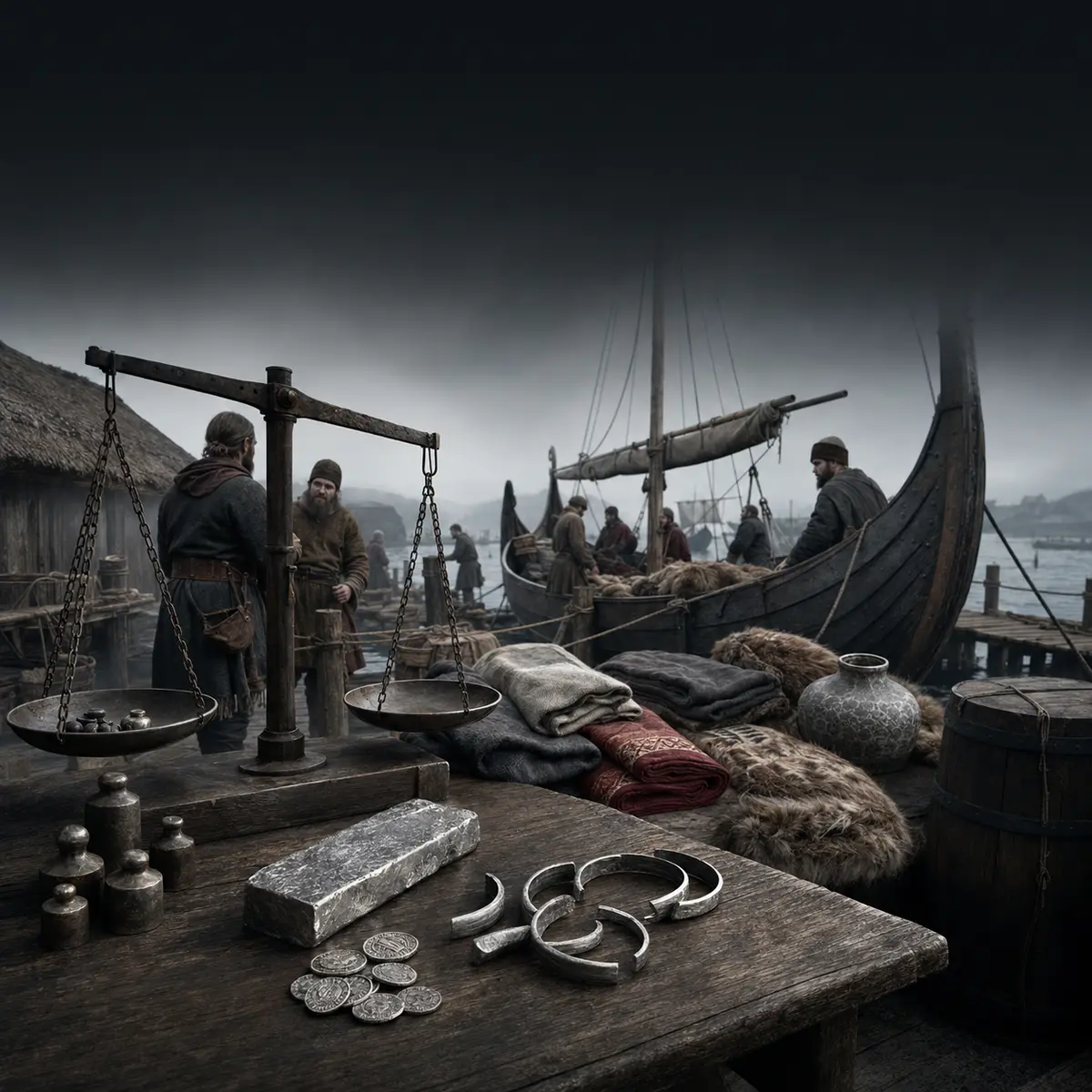
Trade was not a peaceful side story added to the Viking Age. It was one of the systems that made long-distance travel, towns, political power and specialised craft possible. Scandinavian merchants exchanged local products and human captives for silver, textiles, glass, wine, salt and other goods moving through interconnected routes.
Trade Built the Connections
The ships and routes used for raiding also carried merchants, raw materials and finished goods. Trade linked farms and workshops to regional markets, while cargo vessels connected Scandinavian ports with the North Sea, Baltic and river systems of eastern Europe.
Trading and raiding were not completely separate worlds. Both required ships, crews, information, protection and leaders able to organise movement. Goods obtained through exchange, tribute or violence could enter the same markets, making their individual histories difficult to recover from an object alone.
The Viking world moved through cargo holds as well as through battlefields.
Hedeby, Ribe, Birka and Kaupang
Early trading places developed near navigable rivers, natural harbours and major land routes. Ribe emerged as a trading centre in the early eighth century. Hedeby later became a major junction between the Baltic, Scandinavia and continental Europe. Birka in Sweden and Kaupang in Norway served related regional and long-distance networks.
These towns needed more than stalls. Merchants required protection, access to ships and organised space for storage and craftwork. Kings or magnates could guarantee security, regulate activity and collect duties. Markets were therefore sources of political power as well as commercial opportunity.
Silver by Weight, Not Only by Coin
Some transactions involved direct exchange of goods, but silver became increasingly important. Traders used portable balance scales and standardised weights to measure payment. Coins, ingots and jewellery could all supply the required amount of metal.
Silver objects were sometimes cut into fragments often called hacksilver. In a weight-based transaction, a foreign coin did not need to be accepted as the official money of a Scandinavian kingdom. Its value could lie primarily in how much usable silver it contained. Minted coin economies also developed in Scandinavia, but the transition was neither immediate nor uniform.
What Travelled Through the Markets?
Scandinavian exports included furs, hides, iron, rope, fish and other regional products. Imported goods included cloth, glass, ceramics, salt, wine, millstones and raw metals. Soapstone vessels demonstrate that traders moved heavy everyday objects, not only tiny luxury items.
Rare silk, beads and spices attract modern attention, but an exotic object does not prove that one Scandinavian merchant personally travelled from its place of manufacture to its final findspot. Goods could pass through many hands and markets across a chain of exchange.
The Eastern Routes and Islamic Silver
River routes through eastern Europe connected the Baltic with the Black Sea, Caspian region, Byzantium and the Islamic world. Large numbers of Islamic silver coins, usually called dirhams, reached Scandinavia during the ninth and tenth centuries.
Their presence reveals strong economic connections, but not a single direct Viking trade route to every distant mint. Scandinavian travellers entered larger commercial systems involving many peoples, languages and political authorities. The routes shifted when access to silver, security and demand changed.
The Human Cost of the Network
Viking Age trade also moved enslaved people. Captives taken in western and eastern Europe could be transported, sold and forced into labour. Some were carried toward markets connected with Byzantium and the Islamic world.
This cannot be separated from the commercial success of the period. The same networks that carried silver, silk and craft goods also profited from human captivity. Surviving evidence rarely preserves the voices of the enslaved, which makes responsible interpretation especially important.
What Finds Can—and Cannot—Prove
Coins can often be dated and linked to a mint, while weights, scales, workshops, harbour deposits and cargo remains reveal commercial activity. Their discovery location tells us where an object ended its journey, not every stop it made along the way.
The phrase global Viking trade is useful only with care. Scandinavia participated in far-reaching connected economies, but most exchange was conducted in stages. Archaeology shows connection without turning every imported object into proof of a direct expedition.
An object can travel farther than any one of its owners.
Summary
Viking Age trade depended on protected markets, specialised craft, cargo ships and flexible forms of payment. Weighed silver allowed coins and objects from different origins to circulate as measurable value.
The resulting networks connected Scandinavia with distant economies and moved both ordinary necessities and prestige goods. They also included coercion and slavery. The history of Viking trade is therefore a story of remarkable connection, unequal power and real human cost.
Source trail