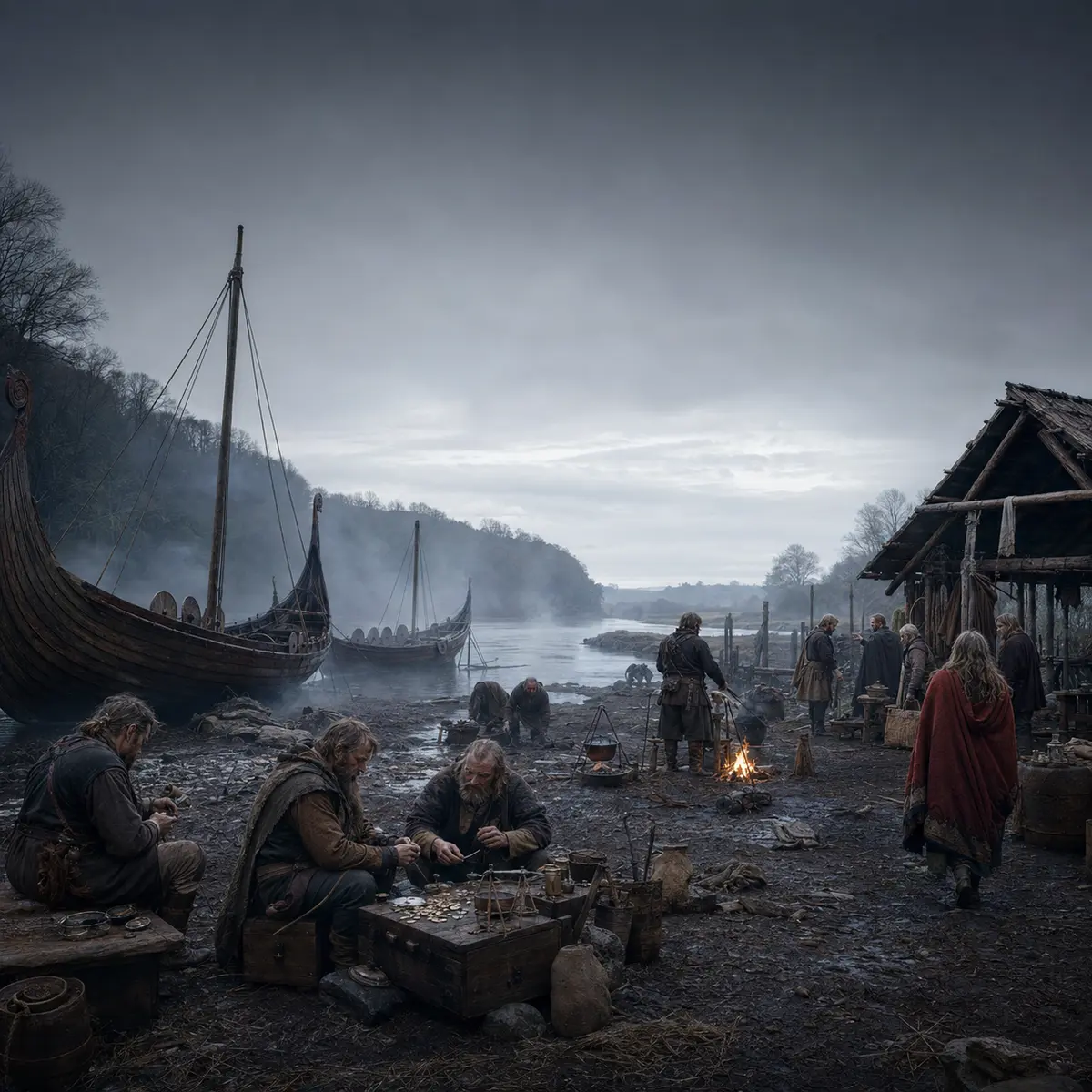
The earliest recorded attacks in western Europe were often short and mobile, but this was not a permanent Viking method. During the ninth century, some forces began staying through winter, demanding political agreements and taking control of territory. Raiders could become soldiers, traders, settlers—or several of these at different stages of the same expedition.
There Was No Single Pattern of Expansion
Viking activity differed by region, decade and leader. A small crew might attack an exposed site and leave quickly. Another group could trade, serve a ruler as mercenaries, collect tribute or return repeatedly to the same coast. Larger coalitions could campaign for years and intervene in local politics.
These roles were not fixed identities. The same maritime networks, leaders and crews could move between raiding, negotiation, trade and settlement when circumstances changed. The word Viking therefore does not describe one permanent occupation or one coordinated Scandinavian plan.
A raid was an activity. It was not the complete identity of every Scandinavian traveller.
Why Overwintering Changed the Scale
A crew that returned home before winter needed speed, information and a safe route back. A force that stayed abroad required food, shelter, repairs, animals, secure access to water and relationships with local communities. Overwintering turned a seasonal expedition into a much more demanding organisation.
Written sources record Scandinavian forces wintering in England before 865, but the campaign associated with the Viking Great Army marked a sustained change in scale. The army arrived in East Anglia in 865 and remained active across several Anglo-Saxon kingdoms over the following years. It should be understood as a changing coalition rather than a single modern national army with a fixed membership.
Torksey: More Than a Military Camp
The Anglo-Saxon Chronicle places the Great Army at Torksey in Lincolnshire during the winter of 872–873. Archaeological research has identified a large camp beside the River Trent in a naturally protected landscape with access to transport routes and resources.
Finds show metalworking, the processing of plunder and exchange using silver. Researchers have argued that several thousand people may have occupied the site, including warriors, craftspeople and merchants. This does not give us an exact census, but it reveals an organised and economically active temporary community rather than a line of warriors waiting for the next battle.
Tribute, Peace and Political Power
Violence was only one way an expedition could gain wealth. Rulers and communities sometimes made agreements with Scandinavian forces. These arrangements could involve payment, provisions, safe passage, hostages or political cooperation.
Later writers and modern summaries often reduce these relationships to Danegeld, but payments varied across period and context. An agreement described by a chronicler as making peace did not necessarily end the conflict permanently. It could buy time, redirect an army or recognise a temporary balance of power.
From Mobile Army to Settlement
Parts of the Great Army eventually took land and settled. York, captured in 866, became a major Scandinavian-ruled centre and developed as a place of craft production and long-distance trade. Scandinavian place-names and archaeological finds also reveal extensive settlement beyond the city.
Settlement was not simply an army putting down its weapons on one date. It included political control, landholding, migration, intermarriage, conversion, local cooperation and conflict. Not every fighter became a farmer, and not every Scandinavian settler had arrived as a raider.
Chronicles and Archaeology Tell Different Stories
Much of the written chronology comes from sources produced within Christian kingdoms affected by Scandinavian warfare. They are essential, but their interests lay in kings, battles, monasteries and divine interpretation—not in documenting every craftworker, trader or family travelling with an army.
Archaeology adds camps, weights, coins, hacked silver, tools, graves, houses and place-names. It can reveal activities omitted from chronicles, although objects do not automatically identify a person's ethnicity or intention. The strongest history comes from comparing both kinds of evidence.
The chronicles show campaigns. Archaeology reveals the communities moving inside them.
Summary
Viking expeditions did not follow one universal path from raid to conquest. Some remained short attacks, while others grew into long campaigns supported by winter camps, tribute, trade and political agreements.
In parts of England, mobile forces became connected to permanent settlement and urban growth. Understanding that transition replaces the image of endless hit-and-run raids with a more complex history of movement, adaptation and power.
Source trail