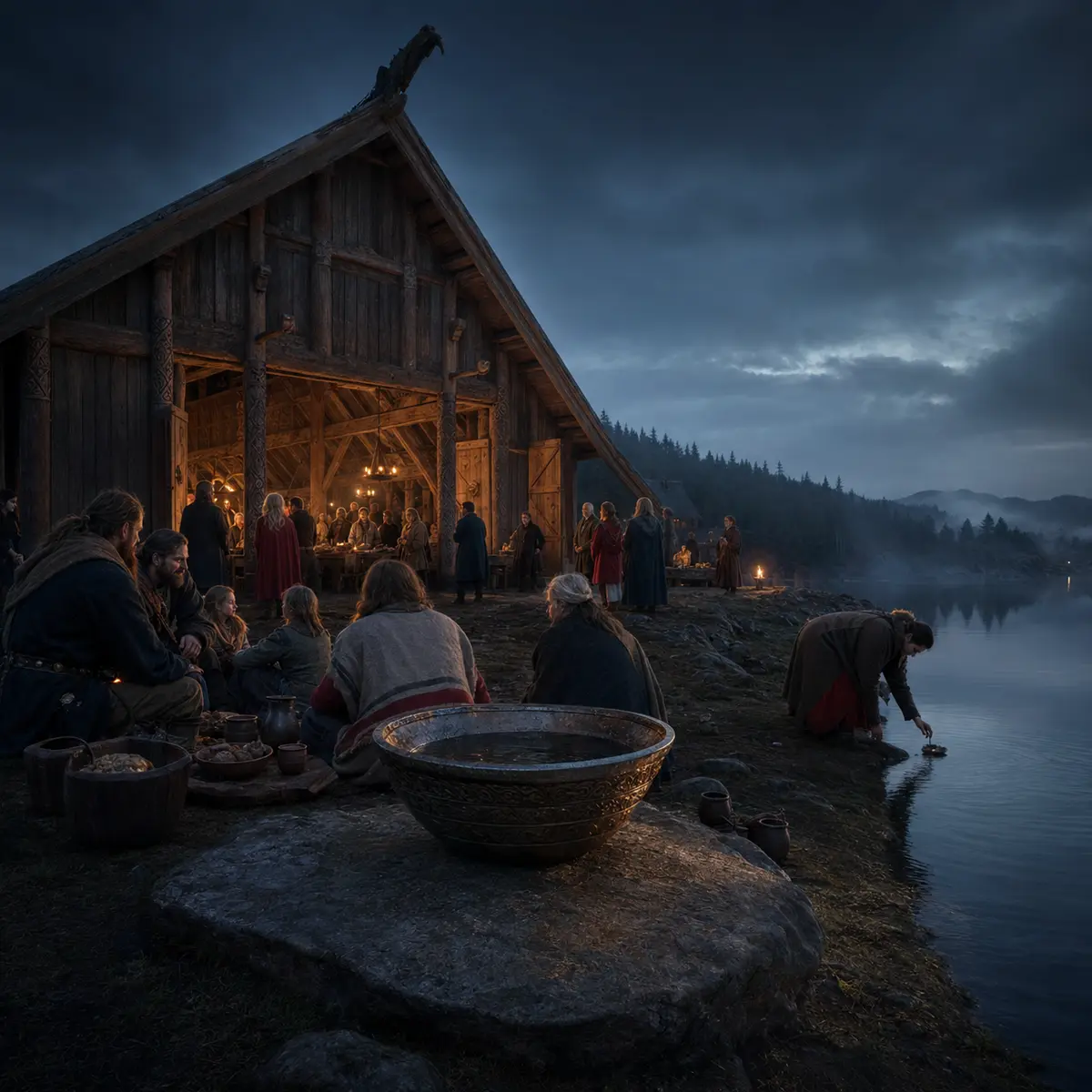
Old Norse religion was not a single church with a shared scripture, fixed creed or central authority. In Viking Age Scandinavia, religious life was embedded in local custom: what communities did at farms, halls, graves, groves, lakes and seasonal gatherings.
There Was No Single Norse Church
The people of Viking Age Scandinavia did not follow one centrally organised religion. There was no universal scripture, institution or authority defining a correct set of beliefs for every region.
Practices differed across time, place and social setting. A magnate's hall, a farm household and a community near a sacred landscape could organise ritual life differently. Particular gods and other beings may also have mattered more in some communities than in others.
The familiar pantheon reconstructed from later Icelandic texts is valuable, but it should not be mistaken for a complete handbook used uniformly by every person in the Viking Age.
Siðr: Custom and Practice
Old Norse sources use the word siðr for custom or customary practice. This is useful because religious life was not separated neatly from law, kinship, farming, feasting and political power in the way a modern category such as religion can suggest.
When Christianity spread, writers could contrast the old custom with the new custom. The distinction points to changing ways of living and performing ritual, not simply to choosing between two lists of doctrines.
For historians, this makes actions especially important: offerings, shared meals, burial choices and the use of particular places may reveal more than attempts to reconstruct a single theology.
Old Norse religion is best approached first as lived practice—not as a lost rulebook.
Blót: Offering, Exchange and Feast
Blót is a central term for sacrificial ritual. People offered animals, food, drink or objects in relationships of reciprocity with gods and other powers. They could seek fertility, favourable weather, peace, protection or success.
Some rituals included communal feasting and drinking in a hall; other offerings were deposited in wetlands, lakes or other meaningful locations. There was no single blót performed identically everywhere.
Medieval writers also describe human sacrifice. Such accounts must be handled carefully: some were written by Christian observers with their own agendas, while a small number of archaeological contexts have been interpreted as possible ritual killings. The evidence does not justify presenting human sacrifice as a routine feature of every Norse community.
Sacred Places, Halls and Landscape
Ritual did not require a building equivalent to a later church. Groves, lakes, springs, burial places, farms and halls could all become meaningful settings.
At Tissø in Denmark, archaeology has revealed an elite complex with specialised halls and deposits of weapons, jewellery, tools and other objects in nearby water. The evidence suggests that political hospitality and ritual activity could operate within the same landscape.
Place-names containing elements associated with sacred sites or gods help map possible cult landscapes. They indicate associations, but they do not tell us exactly what words were spoken or how every ceremony unfolded.
Beyond the Famous Gods
Odin, Thor and Freyja are central to many surviving stories, yet everyday religious life was broader than the most famous divine names. Ancestors, local powers and beings connected to land and household could also matter.
The surviving evidence is uneven. Later poems preserve detailed myths about some gods, while archaeology may reveal repeated actions without recording the names or ideas behind them. A deposited object proves that an action occurred; it does not always identify its intended recipient.
Who Led the Rituals?
There was no single priesthood governing all of Scandinavia. Household heads and magnates could host ritual meals, while later written sources refer to figures such as goðar and völur in particular roles and regions.
These terms should not be turned into universal job descriptions. A goði in Icelandic sources and a ritual specialist represented in archaeology elsewhere do not automatically belong to one standard institution.
Leadership also linked religion to power. A ruler able to host a large feast, control a hall and distribute resources could strengthen social and political relationships through ritual.
What the Sources Can—and Cannot—Tell Us
Archaeology supplies buildings, graves, objects and deposits. Place-names preserve traces of meaningful landscapes. Runic inscriptions sometimes record names or brief appeals. Outside observers describe encounters from their own cultural perspectives.
The Poetic Edda, the Prose Edda and sagas preserve indispensable material, but their surviving manuscripts were produced after the conversion to Christianity. They may carry older traditions while also reflecting later literary choices.
No category should be used alone. The strongest reconstruction compares material evidence, language and texts while leaving uncertainty visible.
Modern Ásatrú and other forms of Norse paganism draw creatively and sincerely on this material, but they are modern religious movements—not unchanged Viking Age practice. Their history deserves separate treatment rather than being projected backwards.
Summary
Old Norse religion was diverse, local and embedded in social life. Rituals connected households and leaders with gods, ancestors, other beings and meaningful places through offerings, feasts and repeated customs.
The safest starting point is therefore practice before doctrine. The myths matter, but they are one part of a larger religious world reconstructed from incomplete and differently dated evidence.
Source trail