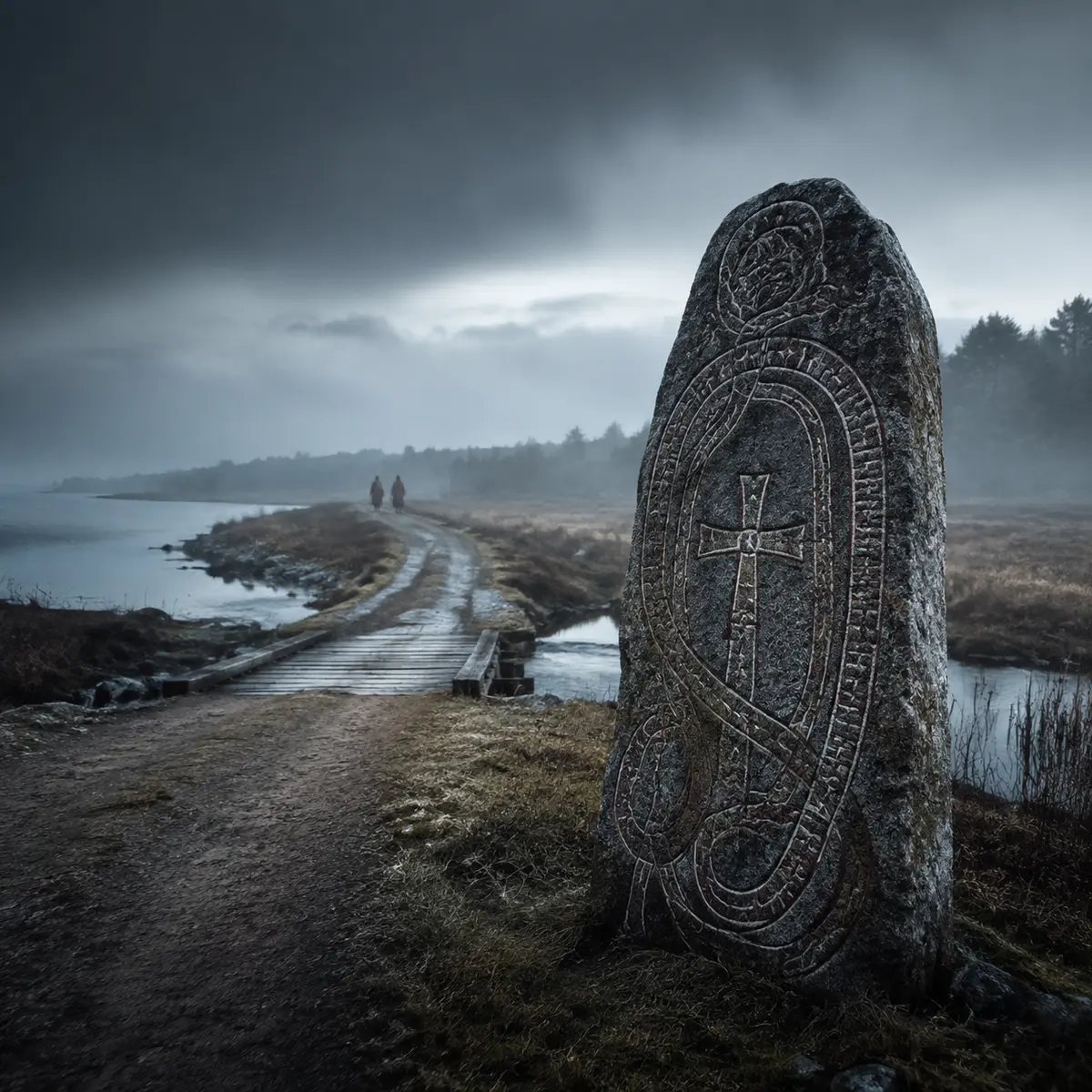
The familiar image of a solitary runestone in a cemetery is misleading. Many late Viking Age stones were positioned where people moved: beside roads, bridges and important routes. Their inscriptions commemorated the dead, identified the living who commissioned the monument and placed a family's story into the public landscape.
A Monument Designed to Be Seen
Most Scandinavian runestones belong to the late Viking Age, with especially dense traditions in parts of Sweden and Denmark. They required suitable stone, skilled labour, planning and access to a place where the monument could stand.
The National Museum of Denmark describes stones positioned near roads and bridges so that travellers would encounter their names and messages. Visibility was part of their function.
A runestone was therefore closer to public media than to a private diary. It carried memory into a shared landscape and showed that a family possessed the resources and relationships needed to commission it.
THE NAME WAS CARVED FOR THE LIVING TO SEE.
Who Raised the Stone—and for Whom?
Many inscriptions follow a recognisable structure: one or more named people had the stone raised, carved or made in memory of another named person. The text may identify a father, mother, spouse, sibling, child, partner or lord.
This formula records two sides of commemoration. It names the deceased, but it also publicly identifies the living commissioner and defines the relationship between them.
Some inscriptions add praise, a title, the cause or place of death, a journey abroad, the name of the runecarver or a warning against damaging the monument. The formula was flexible enough to carry an individual story.
A Memorial Stone Was Not Necessarily a Gravestone
A stone could commemorate someone who died far away and whose body never returned. Even when death occurred locally, the monument might stand beside a route rather than directly above a burial.
The National Museum of Denmark explicitly notes that Viking Age runestones were not necessarily placed at the burial of the person they honoured. Archaeological context must be checked stone by stone.
Calling every runestone a gravestone therefore imposes a modern cemetery model on monuments whose purpose was often broader: remembrance, communication, status and claims about family identity.
Kinship, Inheritance and Social Position
Runestone inscriptions preserve a remarkable archive of relationships. Women commissioned stones for husbands and sons; men honoured parents, brothers and companions; groups commemorated members who died on expeditions.
Naming kin could reinforce inheritance and belonging as well as grief. A monument made a family's presence durable in a landscape used by neighbours and travellers.
Many commissioners belonged to prosperous or powerful households, although stone-raising was not exclusively aristocratic. A Danish inscription from Hørning states that the monument was raised by an emancipated enslaved person, reminding us that the surviving record contains exceptions to simple social rules.
Roads and Bridges Connected Memory with Action
Some inscriptions state that a person built a bridge or improved a route as well as raising a stone. The Old Norse and runic Swedish word translated as ‘bridge’ could include a causeway or prepared crossing through wet ground.
Bridge-building became associated with Christian piety in late Viking Age Sweden. A practical improvement for travellers could function as a good deed performed for a person's soul, while the nearby inscription preserved the names involved.
The monument, route and act of construction formed one public statement: this family remembered, contributed and belonged here.
The Stones Were Not Always Bare Grey Granite
Today most runestones appear as weathered grey surfaces, sometimes with modern paint added to make the inscription readable. In the Viking Age, carved lines and ornament could be painted in strong colours.
The original pigments have usually disappeared, so reconstructions must distinguish detected traces and historically available materials from modern colour choices. One universal red-white-black scheme cannot be assigned to every monument.
Colour would have increased visibility and helped organise the inscription, animal ornament and cross. A newly painted stone beside a road was a more immediate object than its weathered modern appearance suggests.
Many Viking Age Runestones Were Christian
Runes were not opposed to Christianity. Many eleventh-century Swedish and Danish stones carry crosses or prayers asking God to help the dead person's soul.
The large Jelling stone combined commemoration of Harald Bluetooth's parents with royal claims and the statement that Harald made the Danes Christian. Its imagery includes one of Scandinavia's earliest monumental depictions of Christ.
A runic inscription can therefore be Viking Age, Scandinavian and Christian at the same time. Script, language, artistic style and religion are separate questions that must be examined together rather than collapsed into ‘pagan versus Christian.’
What Runestones Reveal—and What They Leave Out
Runestones give historians names, family relations, titles, travel destinations, deaths abroad, religious formulas and occasional references to political events. They are contemporary written sources rather than stories first recorded centuries later.
They remain selective. A short commissioned memorial presents the image a family wanted displayed; it is not a complete biography or neutral census of Viking Age society.
The surviving distribution is also uneven. Sweden preserves thousands of inscriptions, while other regions have far fewer. Stone survives better than the wood on which many ordinary runic messages were probably carved.
From Historical Formula to Modern Design
A modern personalised runestone can draw responsibly on the commemorative structure without pretending to be an excavated object. The design should identify its model, use one appropriate runic system and describe modern names as transliterations where necessary.
The strongest concept is not a random ring of magical runes. It is a relationship expressed through a clear formula: who made the monument, whose name is remembered and what bond connects them.
For contemporary art, the historical function provides a powerful principle: stone gives a name duration, but people give it meaning.
Summary
Viking Age runestones were public monuments of memory. Their inscriptions connected deceased people with living commissioners, kinship, journeys, status, roads, bridges and religious change.
They did not necessarily mark graves, they were often coloured, and many late examples were explicitly Christian. To read a runestone well, begin with its words, location and archaeological history—not with the assumption that every carved rune is magical.
STONE HELD THE WORDS. THE ROAD CARRIED THE MEMORY.
Source trail