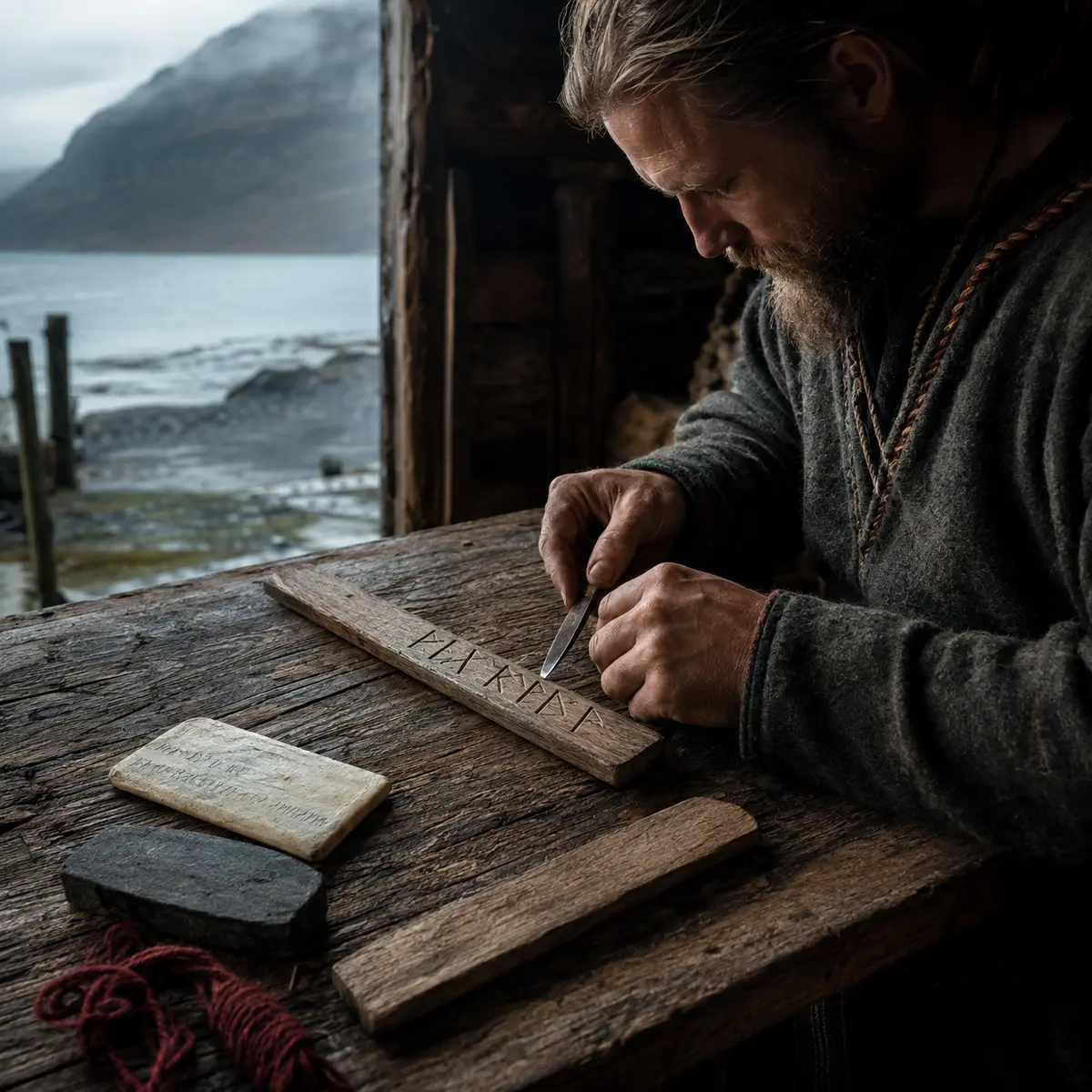
Typing a modern name into a rune converter looks simple: replace each Latin letter with an angular sign. Historically, the problem works differently. Viking Age runes represented the sounds of Scandinavian languages, while the sixteen-sign Younger Futhark had fewer basic characters than the language had sounds. A responsible modern rendering is therefore a documented choice—not the recovery of one hidden, uniquely authentic spelling.
A Rune Row Is Not a Modern Font
Modern typefaces can replace one visible letter with another while leaving the underlying spelling unchanged. Historical runic writing was not designed as a visual skin for Polish, English or present-day Norwegian.
Runes were writing signs used for languages that changed across centuries. The appropriate signs and spelling habits depend on period, region and language. Elder Futhark, Younger Futhark and medieval runes should not be mixed merely because their forms look compatible.
The first question is therefore not ‘which rune means M?’ but ‘which historical writing system and which spoken form are we trying to represent?’
PRONUNCIATION BEFORE ORNAMENT.
Translation, Transliteration and Phonetic Rendering
Translation changes meaning between languages. If a personal name is rendered with runes but remains the same name, it has not been translated into Old Norse.
Transliteration normally maps writing signs from one script to another. Phonetic transcription follows pronunciation instead. Modern rune tools often combine both approaches: they begin with the submitted spelling, then simplify it according to sound-based rules.
A historical reconstruction is a third and more demanding task. It may ask what an equivalent name or phrase could have looked like in a particular stage of Old Norse. That requires linguistic analysis and cannot be produced by a universal letter-substitution table.
Begin with the Sound of the Name
The Viking Ship Museum advises writing modern words and names as they sound. Its examples reduce Christoffer to ‘kristofer’ and render Chanel according to its pronunciation rather than its Latin spelling.
This matters even more across languages. The same letter can represent different sounds in Polish, English and Norwegian, while letter combinations such as ch, sh, kj or cz cannot be understood without knowing the language and the name.
For R3X Studio, Marcin is a useful test case. A converter must be told to follow Polish pronunciation. Reading the six Latin letters through English or Norwegian spelling rules would create a different sequence before the first rune was chosen.
Sixteen Signs Had to Carry More Sounds
Younger Futhark was the characteristic Scandinavian rune row of the Viking Age, but it contained only sixteen basic signs. The spoken language distinguished more sounds than the script could mark separately.
A single rune could therefore cover several related values. The Viking Ship Museum gives practical examples: the u-rune could represent an o-sound, t could represent d, i could represent e and k could represent g.
That ambiguity was not a defect repaired by modern converters. Historical readers used language and context to identify the intended word. A modern rendering that assigns a unique rune to every Latin letter can be less Viking Age in method even when every individual sign is ancient.
Historical Spelling Was Not Modern Spelling
Runic spelling did not normally preserve every feature expected by modern readers. The Viking Ship Museum notes that the same rune should not be repeated directly in a name, giving simplified forms such as ‘ema’ for Emma.
There were no uppercase and lowercase rune sets. Word dividers could appear, but practices varied. Regional forms, individual carvers and changes through time produced further variation.
Two careful modern renderings can consequently differ without one being fraudulent. The responsible response is to explain the method and its limits rather than advertise one result as the only authentic Viking spelling.
An Attested Old Norse Name Is a Different Case
Names such as Harald, Gorm and Thyra appear in surviving inscriptions. Their historical runic spellings can be studied on dated monuments, although even familiar names may occur in variant forms.
A modern name that did not exist in Viking Age Scandinavia has no excavated spelling waiting to be discovered. It can still be represented through a declared contemporary system, but it should not be labelled an attested Viking name.
Meaning also requires separate research. Writing a name in runes does not automatically give it the meaning of the rune names used to spell it. The letters in a modern name are not a chain of personality traits or prophecies.
A Responsible Rune Name Generator
A useful generator should first ask for the rune row: Elder Futhark for an earlier Germanic visual system, Younger Futhark for a Viking Age Scandinavian frame, or medieval runes for a later context.
It should then ask how the name is pronounced, or at minimum which language's pronunciation rules apply. The interface can show the submitted spelling, a normalized sound guide and the runic result as three distinct layers.
Finally, it should label the output. ‘Modern phonetic rendering in Younger Futhark’ is honest. ‘Your authentic Viking name’ claims a historical certainty the tool cannot provide.
SHOW THE RULES. SHOW THE LIMITS.
A Clear Standard for Personalised R3X Artwork
Every personalised design should store the original name, chosen rune row, pronunciation language, normalized form and final rune sequence. The same input and choices must produce the same preview and print file.
Where pronunciation is uncertain, the buyer should approve the normalized form before production. The product description should distinguish a modern rendering from an attested historical spelling.
This makes the educational method part of the product's value. R3X Studio does not merely add angular letters—it documents how a modern identity was carried into an older visual language.
Summary
Writing a modern name in Viking runes is not a one-click translation. It is a controlled modern rendering shaped by pronunciation, historical period and the limitations of the chosen rune row.
Younger Futhark represented multiple sounds with the same signs, historical spelling differed from modern habits and unattested names have no single archaeological form. The strongest converter is therefore not the one that promises certainty—it is the one that makes its decisions visible.
SOUND FIRST. SYMBOL SECOND. CONTEXT ALWAYS.
Free R3X tool
Try the Rune Name Generator
Create a documented modern rendering with the complete 24-rune Elder Futhark art set. Review the normalized form, inspect substitutions and download a transparent PNG.
Open the Rune Name Generator →Source trail