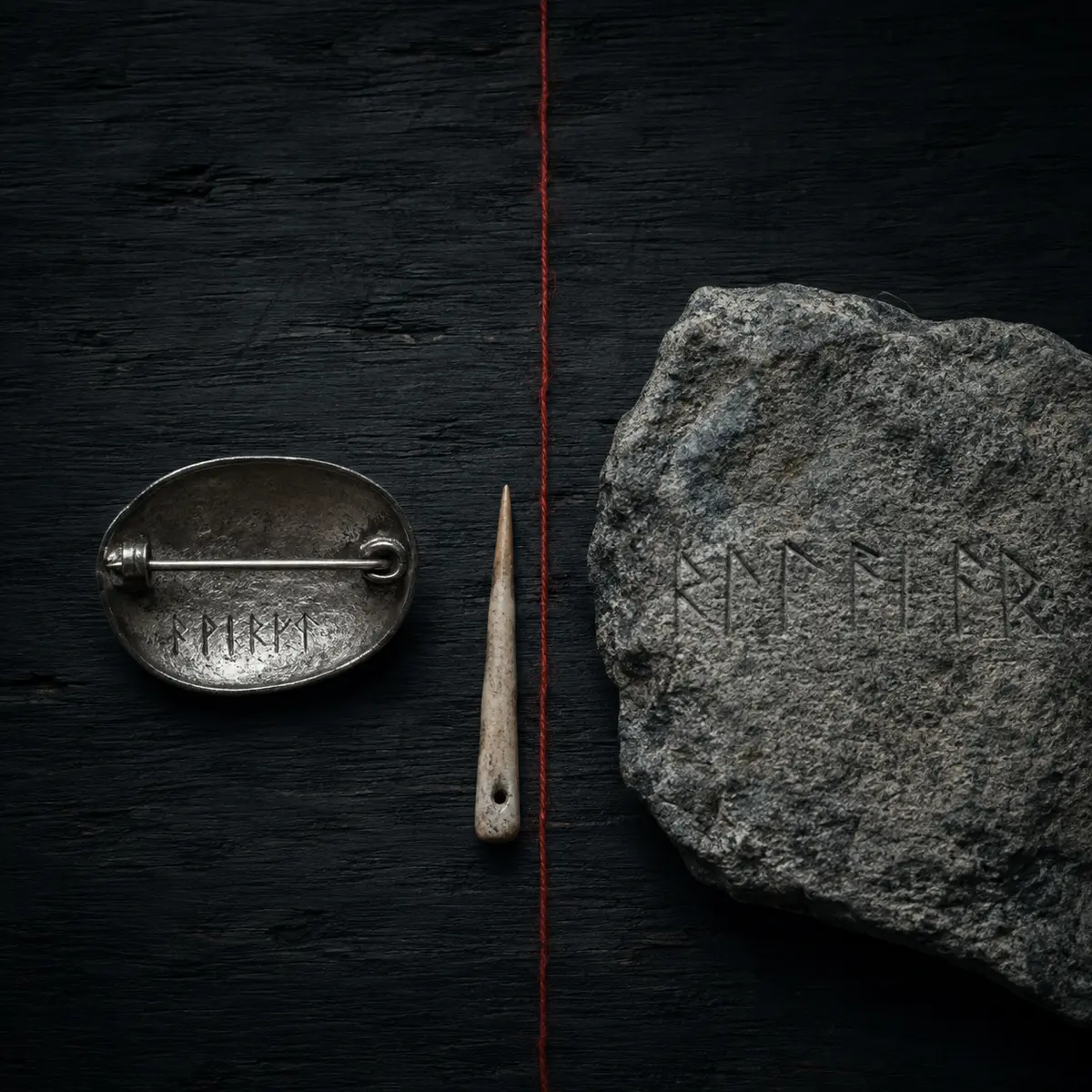
A row of twenty-four runes is often advertised as the ‘Viking alphabet’. It is genuinely ancient, but the label compresses centuries of linguistic change into one image. The Elder Futhark belongs mainly to the earlier Germanic Iron Age; the Younger Futhark became the characteristic runic system of Viking Age Scandinavia.
Runic Writing Changed Over Time
Runes were not one timeless alphabet. Like spoken languages and Latin-letter scripts, runic writing changed across regions and centuries.
The word futhark comes from the sound values of the first six runes, just as ‘alphabet’ comes from alpha and beta. Scholars use labels such as Elder Futhark, Younger Futhark and medieval runes to organise related but different writing systems.
The boundary between them was a transition, not a single reform announced across Scandinavia. Individual inscriptions can contain regional forms, transitional spellings or unusual variants.
DATE THE RUNE ROW BEFORE YOU READ ITS MESSAGE.
Elder Futhark: Twenty-Four Earlier Runes
The Elder Futhark contained twenty-four characters and was used during the early Germanic Iron Age, broadly from the first centuries AD into the eighth century. Its inscriptions preserve earlier Germanic language stages, including Proto-Norse in Scandinavia.
Many surviving examples are short: a personal name, an object's name, a maker's statement or a compact formula carved on jewellery, weapons, tools and stones. The Swedish History Museum's Gårdlösa brooch, dated around AD 300, bears the Elder Futhark inscription ek unwodz—‘I, Unwodz.’
This runic row is historically authentic. It is simply older than the period usually called the Viking Age, conventionally beginning in the late eighth century.
Younger Futhark: Sixteen Viking Age Runes
By the beginning of the Viking Age, the Scandinavian runic row had developed into the sixteen-character Younger Futhark. It is the system found on most Viking Age Scandinavian runestones and many inscriptions on wood, bone, horn and personal objects.
Two major graphic traditions are commonly called long-branch and short-twig runes. They are variants within Younger Futhark, not separate mystical alphabets. Regional preferences existed, but they also overlapped.
Famous monuments such as the Jelling stones belong to this Viking Age runic culture. Their inscriptions show that runes communicated memory, status, political claims and religious change.
Why Did Sixteen Signs Represent More Sounds?
The reduction from twenty-four signs to sixteen did not mean that the spoken language became simpler. Old Norse was developing new distinctions while its runic script used fewer basic characters.
A single Younger Futhark rune could therefore represent several related sounds. The u-rune, for example, might be used for sounds transliterated as u, o, y or ø depending on the word and period. Readers relied on language, spelling conventions and context.
Runic transliteration is consequently not a mechanical one-to-one exchange with modern Latin letters. Specialists distinguish the carved rune, its scholarly transliteration and the reconstructed word or pronunciation.
Runes Were Writing Before They Were Symbols
Viking Age inscriptions record names, family relationships, ownership, journeys, memorials, prayers, jokes and informal graffiti. Many runestones were public messages commissioned by prosperous families and carved by skilled specialists.
Runic writing could also carry ritual or protective force. Some inscriptions invoke Thor, pronounce curses or use the rune row in an apparently protective way. Mythic literature connects Odin with runic knowledge.
That evidence does not turn every rune into an isolated fortune-telling card. The National Museum of Denmark notes that most surviving inscriptions contain practical, everyday messages, while many elaborate stories about runic magic come from later sagas and medieval traditions.
Rune Names Are Not Complete Personality Profiles
Runes had names that helped identify their sound values. Our knowledge of many names comes from later rune poems and manuscript traditions, compared across Germanic languages.
Names such as ‘wealth’, ‘journey’ or ‘hail’ create powerful poetic associations. Modern divination systems expand them into detailed psychological and spiritual meanings, but those systems should be labelled as modern interpretation rather than a fully preserved Viking Age oracle.
A rune can therefore be three things in different contexts: a historical letter, a name with poetic associations and a modern symbol. A responsible description states which layer it is using.
Modern Names in Runes Are Modern Transliterations
Replacing each letter of a modern English or Polish name with a visually similar Elder Futhark rune creates a contemporary cipher-like design. It does not reproduce how a Viking Age runecarver would have written the name.
A historically informed process begins by choosing a period, language and runic system. A Viking Age Old Norse form would normally call for Younger Futhark, followed by decisions about sounds and period spelling—not direct substitution from modern orthography.
Modern transliteration can still be useful for art and personalisation. It becomes misleading only when presented as an exact historical translation or an authentic Viking spelling.
A Clear Standard for Modern Rune Design
Use ‘Elder Futhark’ for the twenty-four-rune early Germanic row and ‘Younger Futhark’ for the sixteen-rune system characteristic of the Viking Age. Do not use the labels interchangeably.
When a design gives each Elder Futhark rune an elemental colour, divinatory meaning or personal message, identify that layer as contemporary Norse-inspired art. The historical rune remains real; the elemental system belongs to the artist.
This distinction strengthens a product. It replaces a generic ‘Viking magic alphabet’ claim with a precise history and an honest modern creative concept.
Summary
The Elder Futhark is a twenty-four-character runic system of the earlier Germanic Iron Age. The Younger Futhark reduced the row to sixteen basic signs and became the main writing system of Viking Age Scandinavia.
Runes could be practical, commemorative, poetic and sometimes magical. Their first function, however, was to write language—and every responsible interpretation begins by identifying the correct period and rune row.
TWENTY-FOUR CAME BEFORE. SIXTEEN WROTE THE VIKING AGE.
Source trail