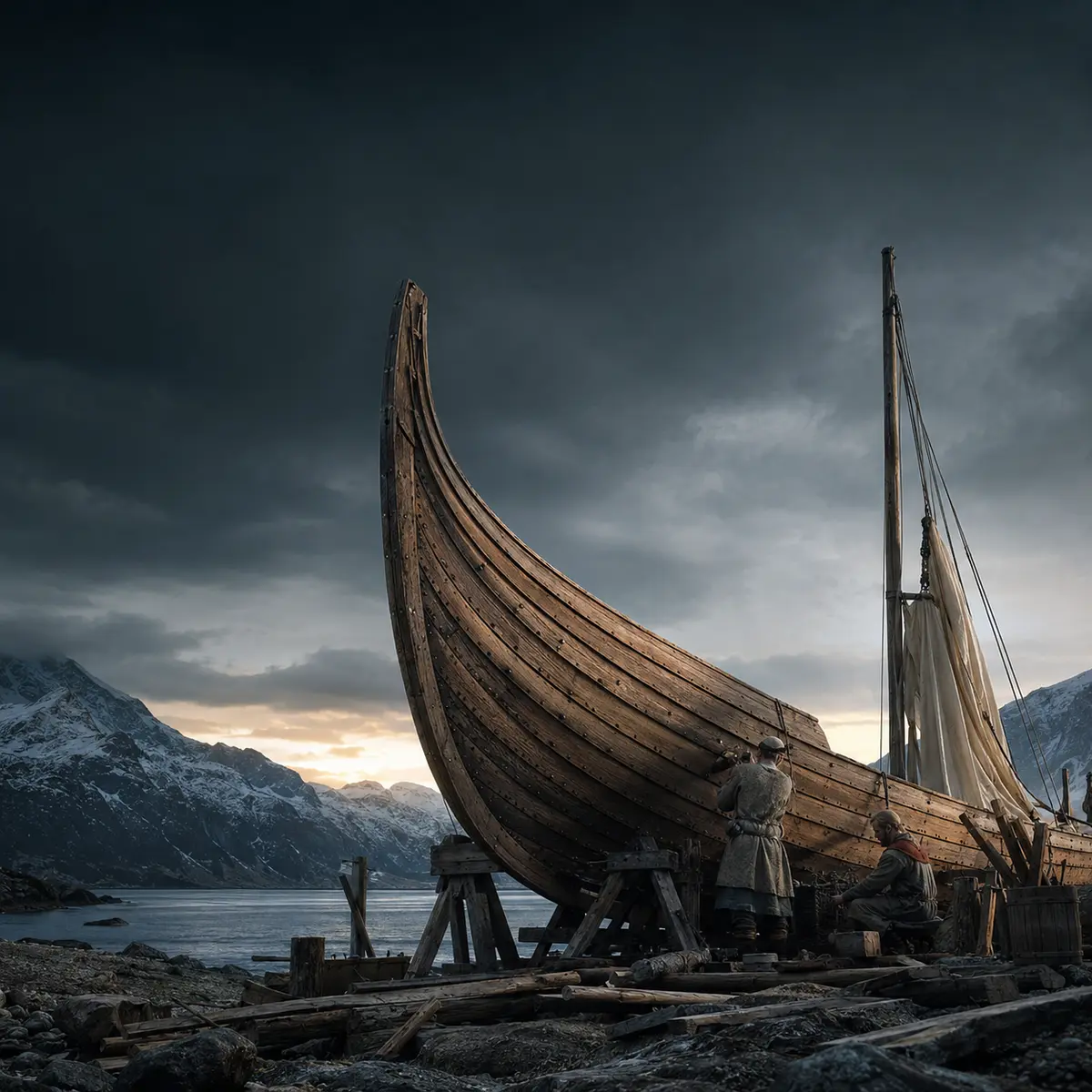
Viking Age expansion depended on ships, but the popular image of a single dragon-headed longship hides an important fact: Scandinavian shipbuilders produced different vessels for different purposes. Warships prioritised speed and crews, while cargo ships needed stability, capacity and seaworthiness.
There Was No Single Viking Ship
The word longship is useful, but it can create the impression that every Viking Age vessel was a narrow warship. Archaeological finds show a more specialised maritime world. Long, relatively narrow vessels could carry large rowing crews and move quickly, while broader cargo ships sacrificed some speed for storage capacity and stability.
Smaller boats supported fishing, local transport and communication. A vessel's form reflected its intended task, available materials, regional building traditions and the waters it was expected to cross. Decoration also varied. The elaborately carved Oseberg ship demonstrates status and craftsmanship, but it should not be treated as the standard appearance of every working vessel.
The longship was an important Viking Age machine—not the only one.
A Light and Strong Clinker-Built Hull
Nordic boatbuilders developed clinker construction long before the Viking Age. In this method, the edges of hull planks overlap. The overlaps strengthen the hull lengthwise, helping produce a structure that is both light and flexible.
The keel and stems formed the vessel's backbone. Planks were shaped and fastened with wooden elements and iron rivets with roves, while internal frames supported the completed shell. The result was not a rigid modern steel hull. Controlled flexibility helped the wooden vessel respond to waves and changing loads.
This technology depended on specialised knowledge: selecting trees, splitting and shaping timber, forging fastenings, sealing seams, making rope and producing a sail. The ship was therefore the product of an entire craft and agricultural economy.
Oars, Sail and Human Skill
Oars allowed crews to manoeuvre without favourable wind, approach a shore and travel through confined waters. The sail made longer journeys more efficient, but sailing still demanded practical knowledge of wind, currents, coastlines, weather and the behaviour of the vessel.
We should be cautious with confident claims about a single Viking navigation system. Archaeology, later texts, experimental voyages and traditional seamanship help researchers test possibilities, but they do not provide a complete instruction manual used by every crew. Experience, memory and local knowledge were probably at least as important as any individual instrument.
Built for Sea, River and Shore
A relatively shallow draught allowed many Scandinavian vessels to approach beaches and enter rivers where deeper ships could not travel. Crews did not always require a constructed harbour. This offered military advantages, but the same mobility also supported trade, settlement and communication.
Ship form still imposed limits. A fast warship filled with rowers was not automatically the best vessel for carrying livestock, timber or heavy goods across open water. Cargo capacity, stability, speed and the number of crew involved practical trade-offs.
What Reconstruction Can—and Cannot—Tell Us
The five Skuldelev ships, excavated in Roskilde Fjord, preserve evidence for several vessel types. At the Viking Ship Museum, full-scale reconstructions are built from the surviving hull shapes, related archaeological finds, period imagery and later Nordic clinker-building traditions.
Sailing these reconstructions is experimental archaeology. It can reveal how a proposed hull, rig and crew perform under real conditions and expose ideas that fail in practice. It does not turn every modern choice into a proven Viking Age fact. Missing timbers, sail details, rope, fastening materials and crew procedures require interpretation, and researchers openly revise reconstructions as evidence improves.
A reconstruction is a tested interpretation, not a time machine.
Summary
Viking Age ships combined inherited clinker-building knowledge with specialised forms suited to warfare, trade, fishing and transport. Their light hulls, oars, sails and shallow draught created exceptional mobility, but the vessel alone was never enough.
Every voyage depended on craftspeople, textile producers, metalworkers, farmers and experienced crews. The famous longship was the visible edge of a much larger social and technological system.
Source trail