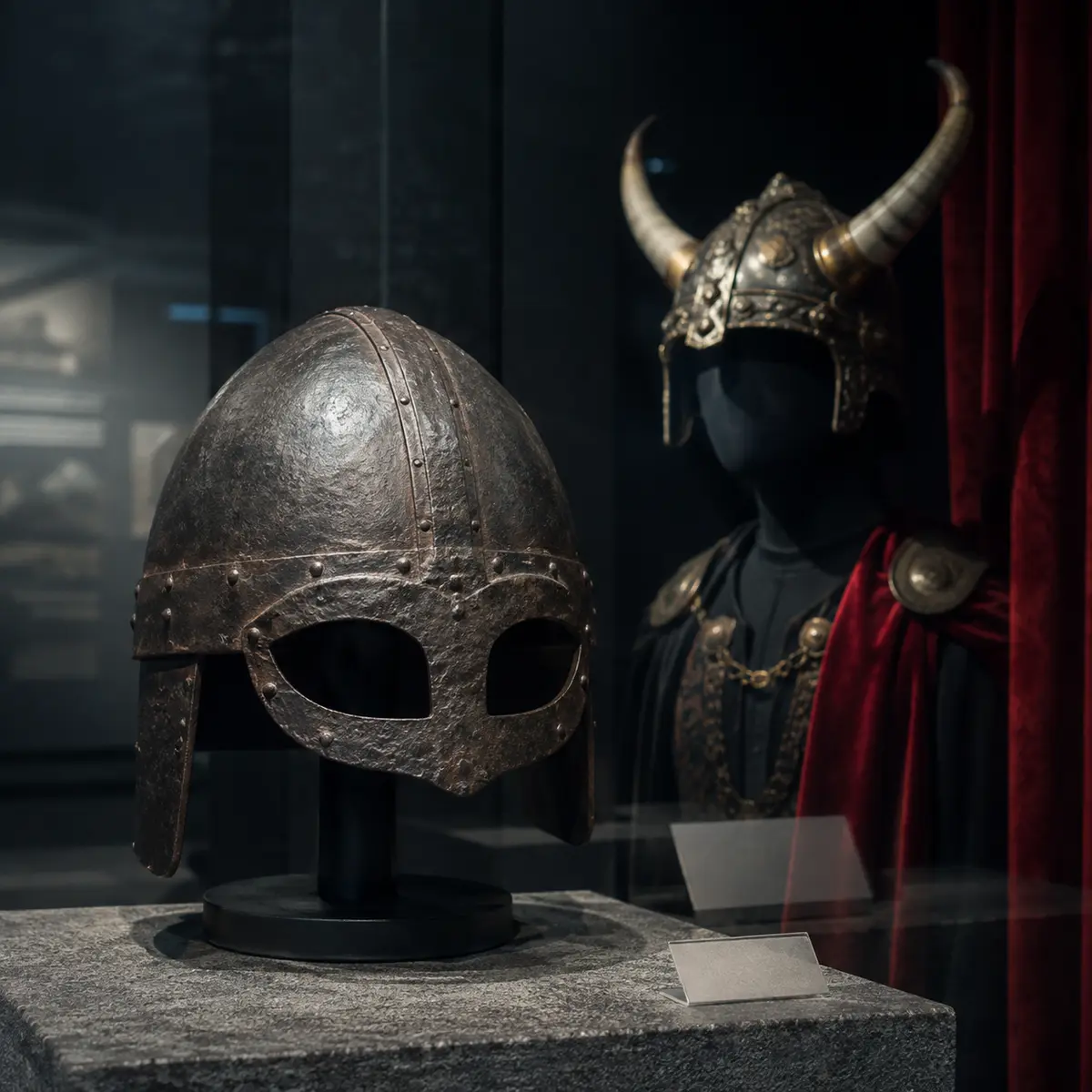
A horned helmet identifies a ‘Viking’ in a second. That visual shortcut is powerful precisely because it is familiar, not because it accurately represents Viking Age warfare. To understand how the image formed, we must leave the ninth century and follow the North through Romantic painting, national history, opera, illustration and film.
A Past Rebuilt by Later Centuries
The Viking Age ended long before modern Scandinavia took shape. Most surviving Old Norse literature was written down in medieval Christian societies, and the material past had to be recovered through antiquarian collecting and archaeology.
Later generations did more than discover that past. They selected, arranged and illustrated it according to their own interests. The Viking could become an ancestor, explorer, national hero, brutal invader or fantasy warrior.
The modern image therefore contains several layers: Viking Age evidence, medieval memory, nineteenth-century interpretation and twentieth- and twenty-first-century mass culture. Separating those layers does not weaken the story. It makes the story more interesting.
Every age inherited the Viking—and rebuilt him in its own image.
Horns Belong to More Than One Time
Real horned helmets exist in the Scandinavian archaeological record, but the famous examples from Viksø belong to the Bronze Age, in the early first millennium BC—well over a thousand years before the Viking Age. Their construction and deposition suggest ceremonial display rather than ordinary battlefield equipment.
Horned human figures also appear in Iron Age and Viking Age imagery, including small metal images and the Oseberg tapestry. Such figures may be ritual, divine, masked or otherwise symbolic. An image of exceptional headgear is not evidence that ordinary warriors used horned helmets in combat.
This is the crucial distinction: horned imagery was not invented from nothing, but later culture removed it from its original uncertainty and turned it into the standard uniform of every Viking.
What Viking Age Helmets Looked Like
Helmet evidence from the Viking Age is limited. The only substantially complete example usually cited is the helmet from Gjermundbu in Norway. Its iron skull, brow protection and face guard were designed for practical defence; it has no horns.
Fragments and protective brow pieces from other sites expand the evidence, but they do not justify one universal helmet design for the whole Viking world. Helmets may also have been less common than films suggest, and preservation or burial customs affect what archaeology can recover.
A responsible reconstruction can follow Gjermundbu or clearly identified fragments. It should still be labelled as a reconstruction because missing materials, lining, finish and regional variation require modern decisions.
Romanticism and the National North
During the nineteenth century, European Romanticism sought emotional, heroic and supposedly ancient national pasts. Norse myths, sagas and archaeological finds offered artists and writers a dramatic northern inheritance.
In Scandinavia and elsewhere, the Viking could be used to imagine national character: independent, maritime, martial and rooted in ancestral land. This was not a neutral recovery of the past. It was medievalism—the creative reuse of medieval material to answer modern cultural and political needs.
Paintings and illustrations gave fragmentary texts a complete visual world. Once repeated in books, exhibitions and public monuments, an artistic choice could begin to look like historical fact.
Opera, Costume and Visual Memory
Richard Wagner's Ring cycle, conceived from 1848 and first performed in full in 1876, greatly expanded modern interest in Germanic and Norse myth. Stage productions needed silhouettes that audiences could recognise from a distance.
Nineteenth-century costume and illustration helped connect horns, wings, animal forms and heavy armour with a theatrical northern antiquity. Wagner did not single-handedly invent the horned Viking: horned imagery and antiquarian speculation already existed. Opera amplified and stabilised a visual language that many artists were building.
The result was memorable design, not archaeological documentation. A stage helmet tells us how a modern audience imagined legend; it does not tell us what a ninth-century fighter wore.
From Stage to Screen
Commercial illustration, advertising, film, comics, sports mascots, games and television inherited the instantly readable horned silhouette. Repetition made the convention stronger than correction.
Other features joined it: oversized axes, fur-covered armour, universal runic decoration and the idea that every Scandinavian man was a raider. Each compresses a varied society into one marketable warrior type.
Pop culture is free to create fantasy. The problem begins when a modern convention is presented as recovered history without a label.
Modern Norse Art: Honest Reinvention
Contemporary Norse art does not need to imitate a museum reconstruction. It can combine elemental colour, mythic atmosphere and modern typography while remaining honest about its status.
Historical, mythological and fantasy collections should use different language. ‘Based on Viking Age evidence’ makes a claim that must be supported. ‘Inspired by Norse mythology’ and ‘modern Norse interpretation’ clearly allow invention.
That distinction gives designers more freedom, not less. The audience can appreciate a dramatic image without being told that every visual choice is ancient.
Historical accuracy and creative power can share the same design—when the label is honest.
Summary
The standard horned Viking is a modern visual construction assembled from much older ritual imagery, nineteenth-century medievalism, theatrical costume and mass-media repetition.
Viking Age battle helmets were practical protective equipment, and the best-preserved example has no horns. Exceptional horned figures in period art should be treated as uncertain symbolic evidence—not a uniform for an entire society.
Source trail