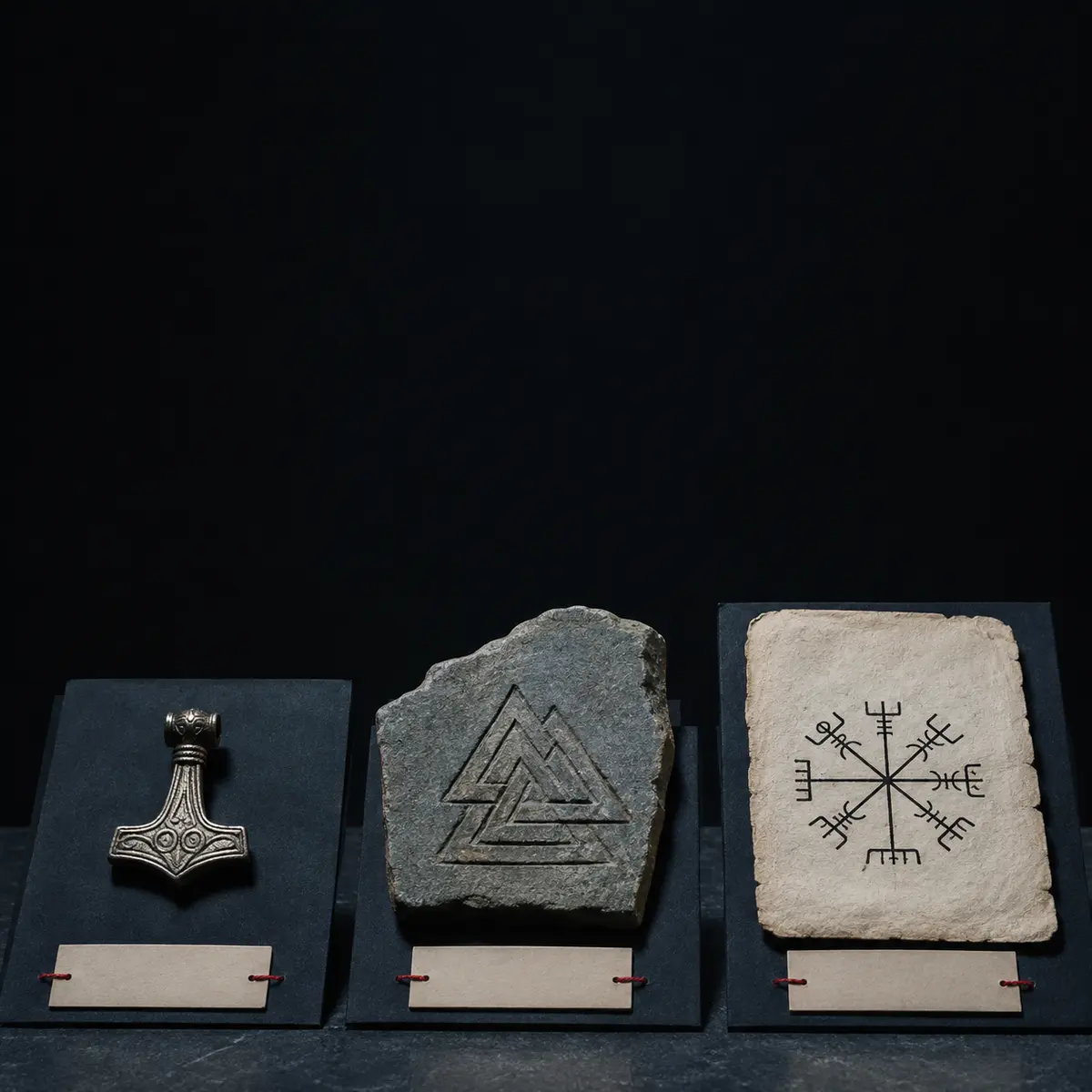
A symbol does not become Viking Age because a modern shop places it beside runes. Mjölnir pendants, the interlocking-triangle motif now called the Valknut and the Icelandic Vegvísir must each be traced to its own objects and manuscripts before meaning is assigned.
Start with the Evidence, Not the Product Label
Modern Norse design often treats every northern-looking mark as part of one ancient symbolic system. Archaeology and manuscripts tell a different story.
For each symbol, four questions should come first: What is the earliest secure source? Is it an object, image or text? What did people of that period call it? How certain is the proposed meaning?
These questions separate documented use from scholarly interpretation and modern personal meaning. All three can be valuable, but they are not interchangeable.
DATE THE SYMBOL BEFORE YOU DEFINE IT.
Mjölnir: Strong Viking Age Evidence
Hammer-shaped amulets are documented Viking Age objects. They occur in several materials and forms, including individual pendants and groups attached to rings. Their shape and archaeological setting connect them with Thor's hammer, Mjölnir.
The myths present Thor as a defender of gods and humans against destructive forces. Later written sources also connect the hammer with hallowing and major life events, while archaeological finds show that the emblem mattered in lived religious practice.
We should still avoid claiming one private meaning for every owner. Protection, religious identity, ritual use and a response to Christian crosses are possible parts of the picture, not a universal instruction preserved with every pendant.
The Valknut: An Old Motif with a Modern Name
Interlocking triple-triangle designs appear on early medieval objects and Gotlandic picture stones, including scenes associated with death, procession or ritual. The archaeological motif is real.
‘Valknut’ is not a name preserved in Viking Age inscriptions or texts for this design. It is a modern label, and no contemporary caption explains the motif's meaning.
Associations with Odin, death and binding are scholarly possibilities based on visual context and later literature. Claims that its nine points certainly represent the Nine Worlds, or that it was a universal protection sign, go beyond the surviving evidence.
Vegvísir: Icelandic, Magical and Much Later
Vegvísir is recorded in Icelandic magical manuscripts, most famously the Huld manuscript, ÍB 383 4to, compiled by Geir Vigfússon in 1860. The manuscript describes carrying the sign so that a person will not lose the way in storms or bad weather.
That source is valuable evidence for nineteenth-century Icelandic magical tradition. It is not a Viking Age object, runestone or navigational instrument.
Calling Vegvísir a ‘Viking compass’ collapses nearly a thousand years of history. It can honestly be described as a later Icelandic magical stave that has become an important modern Norse symbol.
Not Every Angular Sign Is a Rune
Runes are letters belonging to historically attested writing systems. A Mjölnir pendant is an object shaped like a mythological weapon; the triple-triangle design is an image motif; Vegvísir is a later magical stave.
None of these becomes a rune because it uses straight lines or appears in a Norse-themed composition. Mixing the categories makes product descriptions sound impressive but historically weaker.
A bind rune, meanwhile, combines two or more runic characters. Modern bind-rune designs can be meaningful contemporary creations, but their message should not automatically be projected into the Viking Age.
A Practical Scale of Historical Certainty
Mjölnir has strong Viking Age material evidence and a clear mythological identification, although the personal meaning of each amulet remains uncertain.
The interlocking-triangle motif has genuine early medieval evidence, but its original name and precise meaning are unknown. ‘Valknut’ and many popular explanations belong to later interpretation.
Vegvísir has a named manuscript source and stated purpose, but that source belongs to nineteenth-century Iceland rather than the Viking Age. Its history is clear precisely when it is dated correctly.
Modern Meaning Is Real—But It Is Modern
People today use Mjölnir, the Valknut and Vegvísir in jewellery, tattoos, art and contemporary Pagan practice. Their meanings may include protection, identity, courage, fate, guidance or connection with ancestry.
A modern personal meaning does not need a false Viking Age origin to be legitimate. Clear labels respect both the historical source and the person using the symbol now.
Context also matters because ancient-looking symbols can be reused by political movements. No conclusion about a wearer should be drawn from one sign alone; design, accompanying imagery and stated intent must be considered together.
Summary
Mjölnir, the motif called Valknut and Vegvísir do not form one Viking symbolic alphabet. One has strong Viking Age amulet evidence, one is an old but unnamed and uncertain image, and one is securely documented in a much later Icelandic manuscript.
The responsible approach is simple: identify the source, date the evidence, state uncertainty and label modern interpretation honestly.
A SYMBOL NEEDS A SOURCE BEFORE IT NEEDS A STORY.
Source trail