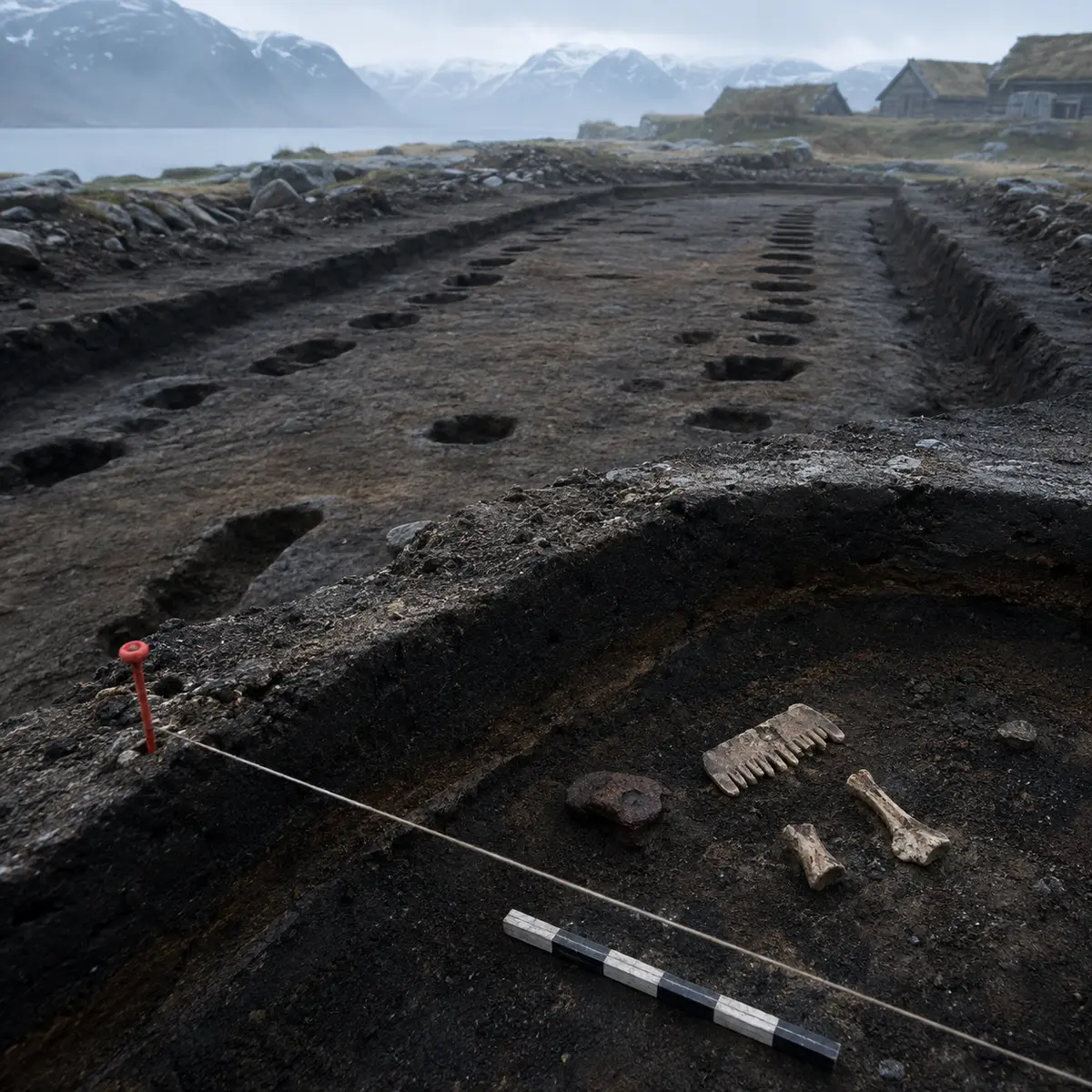
A corroded rivet, a line of dark postholes or a few burnt bones can transform our understanding of the Viking Age. Their meaning does not come from appearance alone. It comes from context: where they were found, beside what, in which layer and through which excavation method.
The Material Archive of the Viking Age
Archaeological evidence includes settlements, graves, workshops, harbours, ships, hoards, tools, human and animal remains, seeds and traces too small to become museum display objects.
This material can reveal construction, diet, craft, trade, health, movement and funeral practice without depending on a saga written centuries later.
It rarely supplies names, motives or complete beliefs by itself. Archaeology is direct physical evidence of past activity, but its interpretation remains a modern analytical process.
An object is evidence. Its meaning is an argument.
Context Turns an Object into a Source
The same iron rivet means different things when recovered from a ship hull, a harbour deposit, a house floor or disturbed ploughsoil. Position, association and stratigraphy connect an object to an event or activity.
A controlled excavation records layers, measurements, soil changes and relationships before removing the find. A loose detector find may still be important, but much of its original context can already be lost.
For this reason, a modest object documented in place can answer more historical questions than an impressive object with no secure provenance.
What Survives Shapes What We See
Soil chemistry, oxygen, moisture, later construction and modern agriculture determine what survives. Stone, pottery and some metals may remain while wood, leather, food and cloth disappear.
Wet, waterlogged or sealed environments can preserve organic material that would vanish elsewhere. Differences between regions may therefore reflect preservation conditions as well as differences in Viking Age behaviour.
Absence must be handled carefully. Failing to find a textile, wooden idol or sail does not automatically prove that it never existed.
A Grave Is a Funeral, Not a Complete Biography
Graves record choices made by the living during a funeral. Weapons, jewellery, animals, vessels and tools may express status, gendered ideals, family claims, ritual roles or hopes for the dead.
They were not necessarily everyday possessions, and one object does not automatically identify an occupation. A weapon does not prove a lifetime spent raiding; a staff-like object does not by itself prove that the buried person practised magic.
Human remains can provide evidence about age, biological sex, injury and disease when preservation allows. The social identity of the individual still requires interpretation.
Objects Do Not Arrive with Belief Labels
Amulets, deposits in water, unusual staffs and mixed burial customs can suggest ritual action. Archaeology can document what was placed, broken, burned or buried.
It cannot usually recover the exact words spoken or the private meaning held by one person. The woman buried at Fyrkat with a staff and henbane may have been a seeress, but the museum itself presents that identification as a reasoned possibility rather than certainty.
Terms from later texts can help interpret a find, but they should not be attached automatically to every unusual object.
Reconstruction Is a Testable Interpretation
A reconstructed longhouse or ship combines surviving evidence with decisions about missing walls, roofs, rigging, colour and technique. Those decisions must remain visible.
Experimental archaeology can test whether a proposed structure stands, a tool works or a ship sails. A successful test demonstrates possibility and performance—not that every Viking Age craftsperson used exactly the reconstructed method.
Reconstructions change when new evidence or better analysis appears. That revision is a strength of the method rather than a failure.
The Strongest Picture Uses Several Sources
Archaeology is compared with runic inscriptions, images, contemporary chronicles, skaldic poetry, later sagas and experimental results. Each source answers different questions and carries different weaknesses.
A building footprint can show size and organisation; a law can describe an expected rule; a saga can preserve social memory; a reconstruction can test physical performance.
Confidence grows when independent forms of evidence converge. Where they disagree, uncertainty should remain part of the conclusion.
The past becomes clearer when different evidence meets in the same place.
Summary
Viking Age archaeology reveals material lives beyond kings, battles and mythology. It shows farms, workshops, diets, burials, ships and the physical systems behind northern society.
But finds do not interpret themselves. Preservation, excavation context, comparison and modern judgement determine what can responsibly be claimed.
Source trail