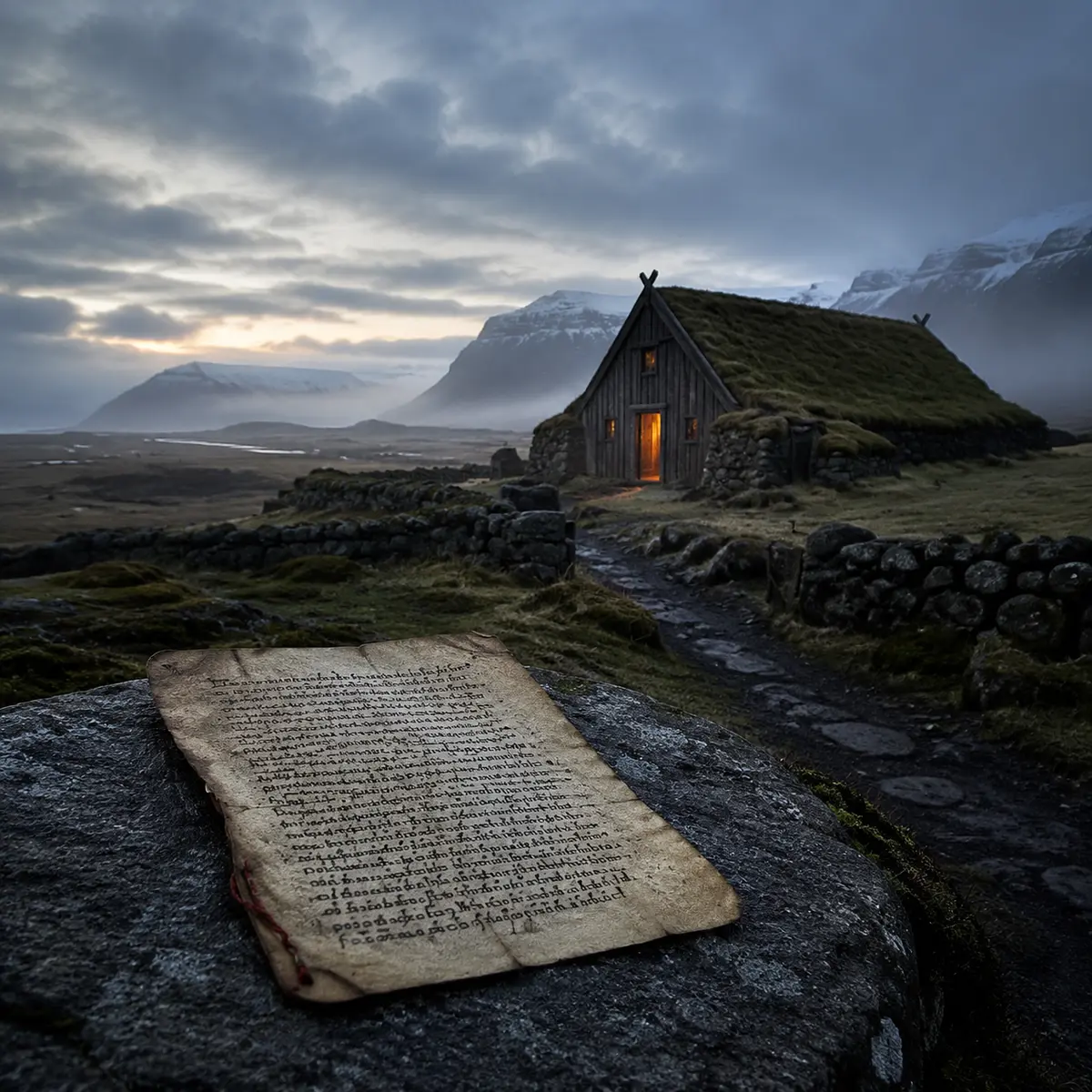
A saga can describe a farm, trace a family conflict and give a character a perfectly timed sentence before death. That detail makes the past feel immediate. Yet many sagas about Viking Age Iceland were written in the thirteenth and fourteenth centuries, long after the events they narrate.
Saga Is Not One Genre
The Old Norse word saga is connected with something said or told, but medieval saga literature contains several different kinds of narrative. Treating them all as one category called Viking stories hides major differences in subject, date and purpose.
The sagas of Icelanders, or Íslendingasögur, focus largely on families living from the settlement of Iceland to the early eleventh century. Kings' sagas organise the lives and conflicts of Scandinavian rulers. Contemporary sagas describe events closer to their authors' own period, while legendary sagas place heroes in a more distant and openly marvellous past.
The historical value of a text therefore begins with identifying which kind of saga it is.
Before asking whether a saga is true, ask what kind of saga it is.
Viking Age Stories Written Centuries Later
Most sagas of Icelanders are set between the late ninth and early eleventh centuries. The earliest surviving manuscripts of this group date from around the middle of the thirteenth century, and saga writing continued into the fourteenth century and beyond.
Their writers worked in a literate Christian society with churches, monasteries, written law and close connections to European learning. The world in which the sagas were composed was not identical to the society they describe.
Older names, genealogies, verses, place-based stories and family memories may have travelled orally before being written. We usually cannot separate every inherited element from the choices of the medieval author or compiler.
Realism Is Not a Recording
Family sagas often use a restrained narrative voice. They describe routes, clothing, legal assemblies, hospitality, marriages and feuds with concrete detail. This style can create the feeling of a documentary account.
Literary realism, however, is not proof that every scene happened as written. Carefully arranged conflicts, meaningful dreams, balanced dialogue and memorable last words reveal narrative craft.
A speech attributed to a tenth-century character cannot be treated as a word-for-word transcript preserved for three hundred years. It may express a remembered reputation, a later moral judgement or the author's design.
What the Sagas May Preserve
The sagas are valuable evidence for how medieval Icelanders imagined their ancestors and organised the past. They preserve dense networks of personal names, kinship, farms, routes and local landscapes.
Some information may derive from durable social memory. A farm name, burial place or relationship between families could remain meaningful within a community for generations. Embedded skaldic verses may also contain material older than the prose surrounding them.
This value does not require every event to be factual. A saga can preserve historical memory while reshaping chronology, motivation and dialogue.
A Window—and a Thirteenth-Century Mirror
Sagas set in the Viking Age can reflect the concerns of the centuries in which they were written: authority, inheritance, Christian morality, legal order and the dangers of escalating violence.
A description may therefore tell us something about an earlier tradition and something about the later society that selected and narrated it. These two layers are not always cleanly separable.
Instead of asking whether a whole saga is history or fiction, researchers examine individual claims, episodes, poems and manuscript variants.
Test the Story Against Other Evidence
Archaeology can test saga descriptions of settlement, buildings, travel and land use. Place-names, law codes, annals, genealogies and independent foreign sources provide other points of comparison.
Agreement can strengthen a historical interpretation, but it does not validate every scene in the same saga. Disagreement can reveal literary invention, chronological compression, manuscript change or an incomplete archaeological record.
The safest method is convergence: confidence grows when different and independent kinds of evidence point in the same direction.
A saga becomes stronger historical evidence when another source can meet it.
There Is Not Always One Fixed Saga
Many sagas survive in several manuscripts copied at different times. Scribes could alter spelling, wording, sequence and detail, while some narratives exist in substantially different versions.
A modern translation usually presents one edited text assembled through comparison of manuscript witnesses. Readers rarely encounter a completely untouched medieval original.
For precise quotation, the saga title, chapter, translation and edition matter—especially when words are used commercially as supposedly authentic Viking statements.
Summary
The Icelandic sagas are neither transparent chronicles nor disposable fiction. They are medieval literary works carrying older memories, names, poetry and landscapes into written form.
They reveal the Viking past most responsibly when read beside archaeology and other sources—and when their realism, manuscript history and later Christian context remain visible.
Source trail