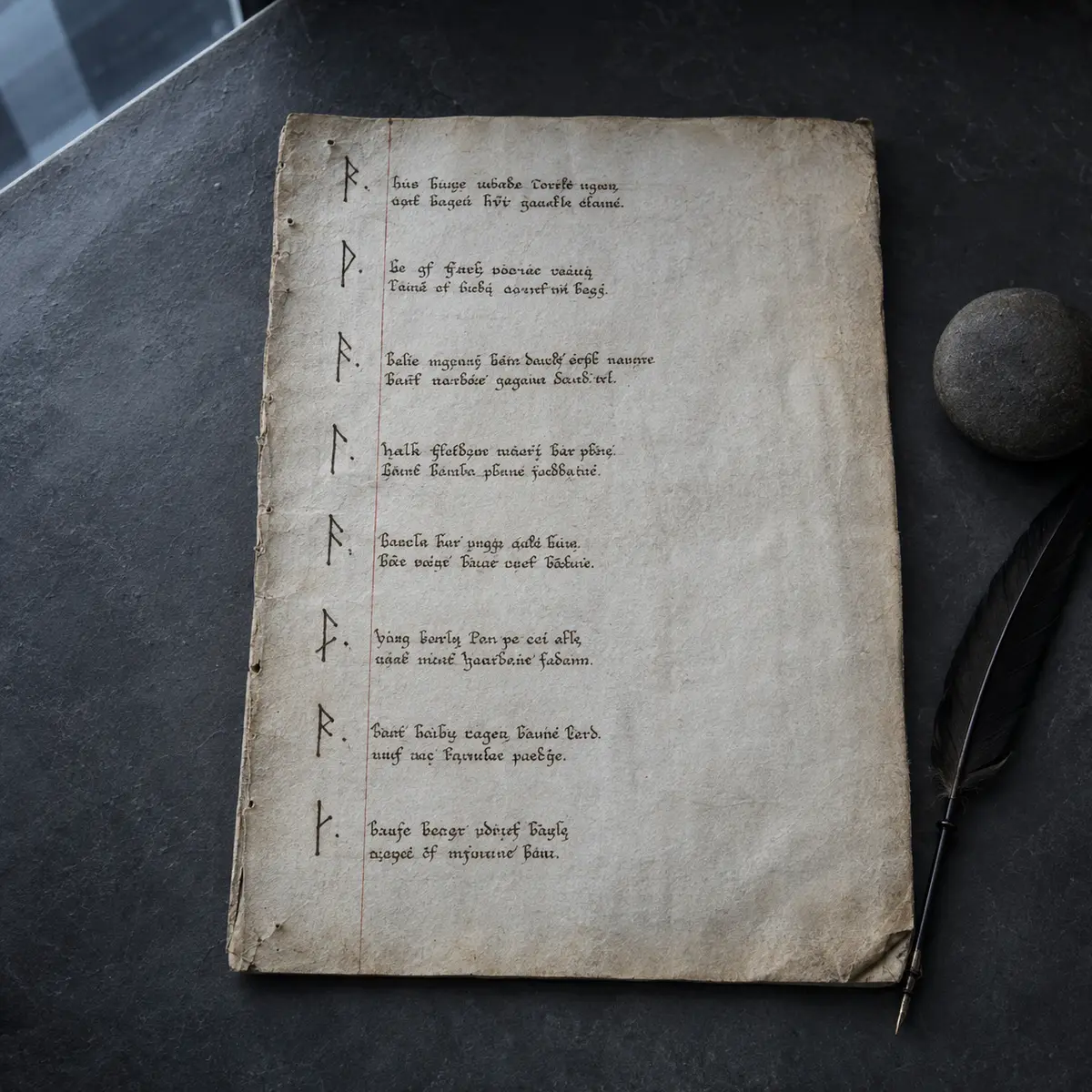
Modern rune guides often place a single meaning beneath each sign: wealth, strength, journey, protection or transformation. Those labels are partly inspired by historical rune names and poems, but the source material is more complex. The Old English, Norwegian and Icelandic rune poems belong to different languages, rune rows and manuscript histories. Their stanzas are poetry—not a universal magical dictionary.
A Rune Poem Is an Alphabet in Verse
A rune poem moves through a rune row in order. Each stanza begins from the conventional name of one sign and develops an image, proverb, riddle or piece of wisdom around the thing that name denotes.
The poems helped organise knowledge about the script, but they are more than bare teaching lists. Their compact verses discuss wealth, weather, travel, illness, social duty, danger and mortality.
A rune can therefore function at several levels at once: as a written character, a sound, a name and a poetic subject. None of those levels automatically turns the stanza into a spell.
THE POEM EXPLAINS A NAME—NOT A UNIVERSAL SUPERNATURAL POWER.
Three Traditions, Different Rune Rows
The three best-known traditions are the Old English Rune Poem, the Old Norwegian Rune Poem and the Icelandic Rune Poem. They are related, but they are not three copies of one unchanged text.
The Old English poem follows the expanded Anglo-Saxon fuþorc and contains more signs. The Norwegian and Icelandic poems organise the sixteen-rune Younger Futhark used in medieval Scandinavia.
Their languages, metres, dates and cultural settings differ. Combining all of their verses into one table can be useful for comparison, but the result is a modern synthesis rather than a historical document.
The Poems Preserve Names—Not One Dictionary
Rune names were meaningful words such as wealth, hail, ice, human or water. A poem could use the named object to explore consequences and associations rather than define an abstract concept.
The stanza for wealth makes the problem clear. Related poems connect wealth with comfort, generosity, conflict among relatives, fire-like brilliance and the danger of hoarding. Reducing this material to the single keyword ‘abundance’ removes its social tension.
The poems are evidence for historical names and imagery. They do not prove that every rune user assigned each sign one fixed psychological, prophetic or magical value.
ONE NAME COULD OPEN SEVERAL IMAGES.
Lost Manuscripts and Late Witnesses Matter
The sole medieval manuscript known to contain the Old English Rune Poem was damaged beyond recovery in the Cotton Library fire of 1731. Its text survives through an edition and engraved reproduction published by George Hickes in 1705.
The Norwegian poem also has a complicated transmission. Its medieval manuscript was lost in the Copenhagen fire of 1728, but early printed and handwritten copies preserve the text for comparison.
The Icelandic versions survive in later manuscripts with their own variants. Every modern transcription and translation therefore depends on a chain of copying, editing and scholarly decisions.
Christian Scribes Preserved Older Runic Lore
The poems were transmitted within literate Christian cultures. Their survival does not mean that the scribes were secretly copying a complete pagan ritual manual.
Older mythic names and traditional images could remain useful inside Christian learning, proverbial wisdom and antiquarian interest. Some stanzas can also reflect Christian ideas or reinterpret older material through a post-conversion worldview.
The categories ‘pagan’ and ‘Christian’ do not divide every line cleanly. Medieval authors inherited, adapted and taught knowledge from several layers of the past.
Elder Futhark Names Require Reconstruction
No surviving Elder Futhark rune poem provides a complete twenty-four-stanza guide from the period when that rune row was used. The familiar reconstructed Proto-Germanic names are scholarly forms, marked conventionally with an asterisk because they are not directly attested in that exact form.
Linguists compare later Old English and Old Norse rune names, inscriptions and related words to reconstruct earlier forms. The method is evidence-based, but reconstruction is not the same as reading a preserved ancient label.
This is why a 24-rune Elder Futhark chart should distinguish the historical sign, the reconstructed name, a literal gloss and any modern interpretive keyword.
Why Modern Rune Keywords Are Modern
Contemporary rune books and decks often standardise each sign as one positive quality, challenge or life lesson. That creates an accessible system for reflection and divination.
The practice is modern even when it draws intelligently from old names and poems. Historical stanzas are contextual, sometimes contradictory and rarely shaped like the concise guidance printed on a contemporary oracle card.
A modern keyword can be meaningful without being advertised as the exact definition used by all ancient Germanic peoples. Clear labelling protects both the historical source and the living practice.
A Better Source Standard for Rune Design
R3X Studio can give every rune design a four-layer source card: historical sign, reconstructed or attested name, literal gloss with poem reference, and contemporary R3X interpretation.
For example, an elemental artwork may use fire to visualise conflict, energy or transformation. The description should identify that elemental treatment as the studio's own visual language rather than a fixed meaning written in a medieval poem.
Showing the method creates a stronger product than a generic list of mystical keywords because the customer can see where historical evidence ends and new design begins.
NAME THE SOURCE. LABEL THE NEW MEANING.
Summary
The Old English, Norwegian and Icelandic rune poems preserve conventional rune names through compact catalogue verse. They share inherited material, but they belong to different rune rows, periods and manuscript traditions.
Their stanzas provide names, metaphors and cultural reflection—not one fixed system of magical or divinatory meanings. Modern rune practice can build on them honestly by citing the source, preserving ambiguity and clearly marking contemporary interpretation.
THE NAME IS HISTORICAL. THE KEYWORD MAY BE NEW.
Source trail