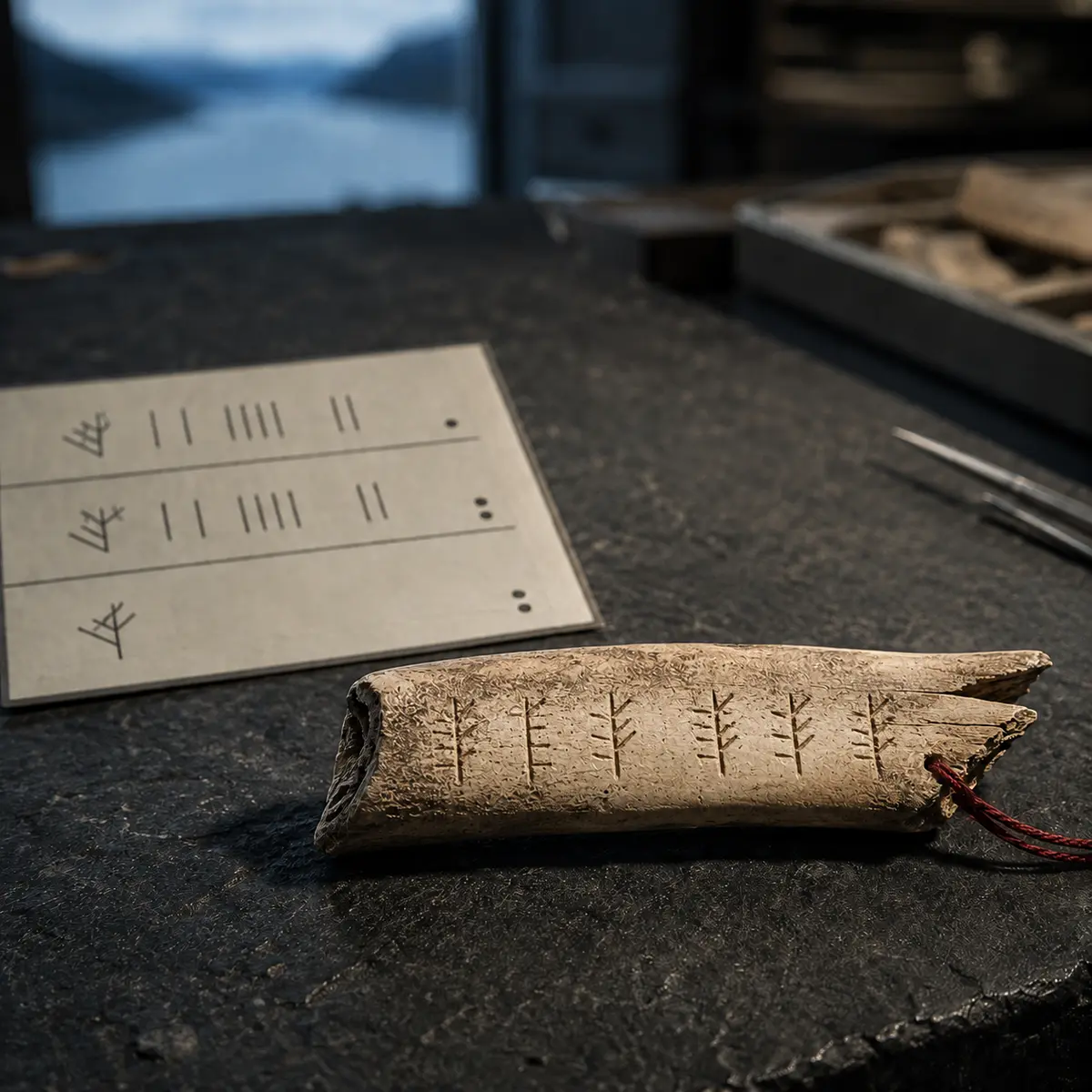
Some runic inscriptions were designed to resist immediate reading. Their signs may resemble branches, repeated strokes or decorative figures rather than ordinary runes. Many such systems encode a rune through two pieces of information: the group of the futhark to which it belongs and its position inside that group. They reveal technical play, education and social display as much as secrecy.
Cipher Runes Were Not Another Rune Row
Cipher runes did not normally replace the futhark with an unrelated secret alphabet. They encoded information about an existing rune row, allowing a reader who knew the key to recover ordinary letters.
Runologists often distinguish cipher runes from the broader category of cryptic runes. A true cipher follows a recoverable system, while a cryptic sign may remain ambiguous, ornamental or impossible to decipher with confidence.
The first task is therefore not to assign a mystical meaning to the mark. It is to test whether its repeated features correspond to a consistent writing rule.
THE SIGN HID A LETTER—NOT A SECOND SUPERNATURAL ALPHABET.
The Futhark Became a Coordinate System
The rune row could be divided into three groups traditionally called ættir. A coded sign then supplied two values: which group contained the rune and where the rune stood within that group.
One side of a stem might record the group and the other the position. Other methods represented the same pair of numbers through long and short strokes, arms of a cross or features inside a picture.
The order of the groups could be reversed, and conventions were not identical in every inscription. Decoding requires the correct rune row, numbering direction and visual key.
Branches, Ice Runes, Hairs and Fins
Twig or branch runes attach counted strokes to a central line. The numbers can identify the rune's group and its place inside that group.
The isruna method uses groups of long and short strokes. Uppsala University's Rune Blog notes that it was in use by at least the ninth century and appears in the carver's signature on the Rotbrunna stone, U 1165.
The same numerical principle could be disguised as hairs in a beard, fins on a fish or branches on a tree. The picture was not merely decoration: its countable features could carry the encoded letters.
The Rök Stone Used More Than One Challenge
The early ninth-century Rök stone is famous for its long and difficult inscription. It combines straightforward runic text with several techniques that complicate reading.
Its carver used older-looking rune forms as a code, shift systems in which another rune replaces the expected one, and numerical or branch-based devices. The stone therefore tests more than the reader's ability to recognise ordinary Younger Futhark.
Modern interpretations of the complete text remain debated. Agreement that a section is encoded does not guarantee agreement about every reconstructed word or the monument's larger message.
Why Hide a Runic Message?
Secrecy is one possible answer, especially when a message concerns restricted knowledge, a personal communication or a taboo subject. It is not the only answer supported by the material.
Medieval examples suggest entertainment and education. Encoding a phrase forced the writer and reader to remember the futhark order, recognise numerical patterns and demonstrate control of the script.
Cryptography could also communicate status. A difficult inscription challenged its audience and displayed the carver's specialist knowledge, turning literacy itself into part of the monument's performance.
TO ENCODE A MESSAGE WAS ALSO TO DISPLAY THE KEY.
A Small Bone Could Carry a Written Puzzle
A cattle-rib fragment from medieval Sigtuna, catalogued as Sl 72, carries a numerical stroke system on one side and twig runes on the other. Its archaeological layer is dated to around 1090–1105.
Another Sigtuna rib, Sl 89, includes the challenge Ráð þat—approximately ‘Interpret that’ or ‘Read that’. The invitation makes the social function of the puzzle unusually explicit.
These modest objects are important because they show cryptography outside monumental stone carving. Runic skill could be practised, tested and enjoyed on portable pieces of bone.
Hidden Did Not Automatically Mean Magical
A coded inscription may have carried religious or ritual content, but encryption alone does not establish that function. A joke, name, signature or drinking message could also be hidden behind an elaborate system.
Scholars assess the decoded words, archaeological context and object before proposing magic. The visual mystery of the marks is not sufficient evidence.
This is the same discipline required for bindrunes: difficulty is a property of the writing, not proof that the object contained supernatural power.
Cipher Runes Are Not the Same as Staveless Runes
Staveless runes are a reduced graphic variant of Younger Futhark in which the main vertical stave has been removed. Their appearance can seem obscure to a modern viewer, but they still function as direct letterforms.
Cipher runes require a decoding operation: counting, locating a rune within an ætt or applying another transformation. A script can look unusual without being encrypted.
The difference matters in design. Labelling every unfamiliar form as a secret rune erases several distinct historical writing traditions.
A Responsible Modern Cipher-Rune Design
A modern encoder should first declare its rune row and the order of its ættir. It should then show how each pair of counts maps back to a letter and provide a plain transliteration for verification.
For R3X Studio, cipher runes can become a premium interactive layer: the customer sees the encoded design first and receives a key explaining the message. The appeal lies in knowledge, challenge and discovery rather than invented claims of ancient magic.
A historical example should retain its date and source. A newly encoded modern phrase should be labelled as contemporary work built with a documented runic cipher principle.
THE MESSAGE IS HIDDEN. THE METHOD SHOULD NOT BE.
Summary
Cipher runes turned an ordered rune row into a system of coordinates, counts and substitutions. Branches, strokes, hairs, fins and other visual devices could all encode the information needed to recover a letter.
Writers used these methods for secrecy, education, play, aesthetic challenge and social display. Some contexts may have been ritual, but cryptography itself was not automatic evidence of magic.
THE OLD CODE WAS SOMETIMES LITERALLY A CODE.
Source trail