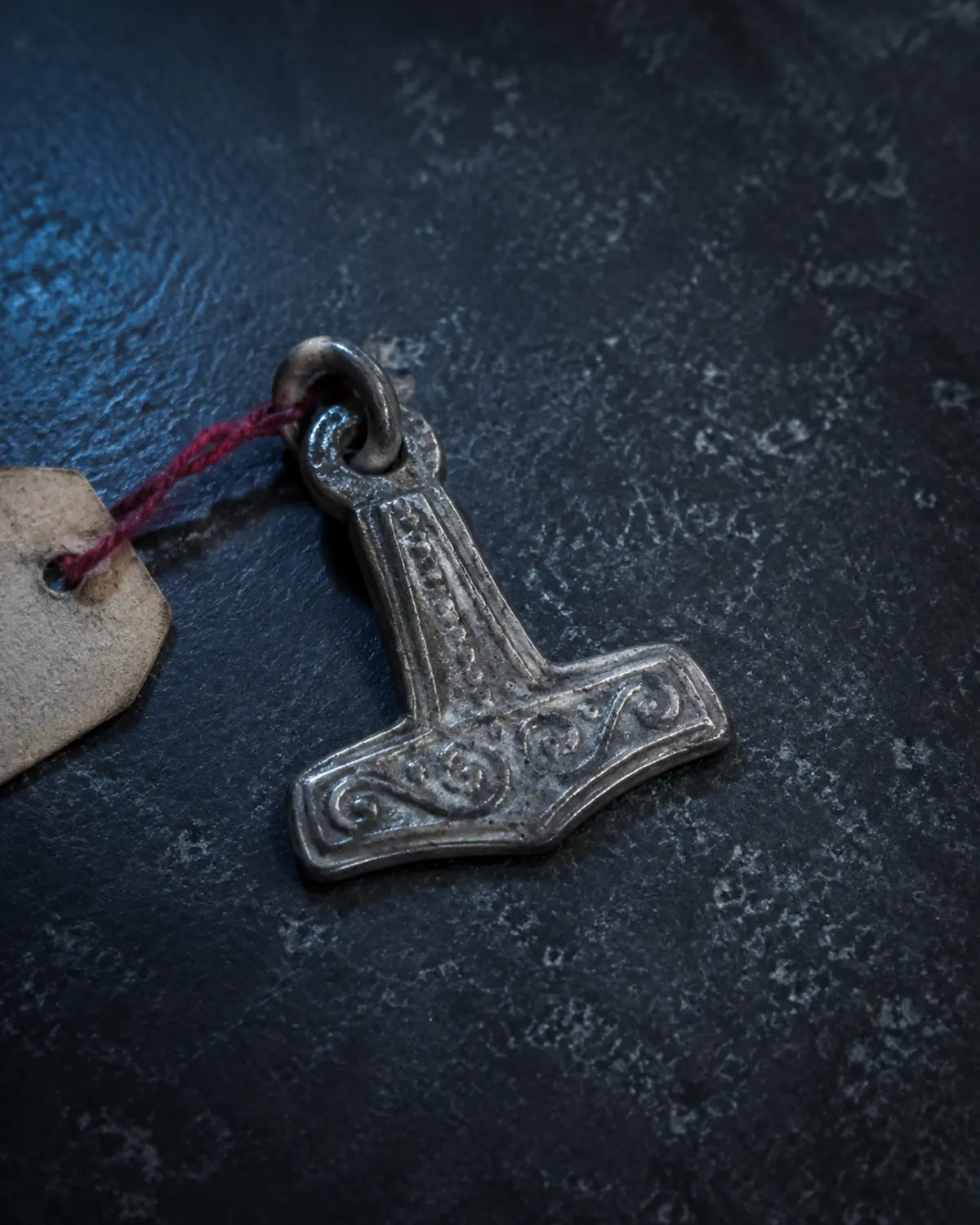
Mjölnir is often reduced to a logo for thunder, masculinity or combat. The surviving evidence gives it a broader history. Medieval poems describe the hammer defending the ordered world and consecrating a marriage, while Viking Age pendants and hammer rings place its form on bodies, in graves, at settlements and within changing religious landscapes.
The Hammer in Myth
In Norse mythology, Mjölnir belongs to Thor. He uses it against giants and other forces threatening the worlds of gods and humans. The weapon returns after being thrown and represents controlled power used to defend cosmic order.
The poem Þrymskviða gives the hammer another function. After it is stolen, Thor recovers it during a disguised wedding feast. Before the reversal, the hammer is placed in the bride's lap to hallow the marriage. Violence and consecration therefore belong to the same mythic object.
These stories survive in medieval texts written down after Scandinavia's conversion. They preserve older traditions, but they are not direct captions for every archaeological pendant.
THE MYTHIC HAMMER DESTROYS THREATS—AND RESTORES ORDER.
The Archaeological Symbol
Hammer-shaped pendants are known from Viking Age contexts across Scandinavia and beyond. A tenth-century amulet found at Købelev on Lolland provides unusually direct evidence: its short runic inscription reads hmar × is, understood as “this is a hammer.”
The Købelev object confirms that at least this form was intentionally recognised as a hammer. Association with Thor becomes especially strong when the pendants are compared with literary descriptions, runic invocations and other religious material.
An identified shape does not reveal one universal personal meaning. The same emblem could participate in dress, protection, ritual, memory, community identity or several of these at once.
Materials and Contexts
Surviving Mjölnir pendants vary. Examples were made from iron, silver, copper alloys and occasionally other materials. Some are plain; others carry stamped, punched or animal-style ornament. Their owners were not choosing one standardised product.
The British Museum records a fragmentary silver hammer pendant from tenth- to eleventh-century Scotland. Swedish finds include individual silver pendants and iron rings carrying several small hammer forms.
Hammer rings from the Mälaren Valley occur in cremation graves, often near the top of burial urns, and also at settlement sites. Their placement supports a ritual connection, although the exact action performed with each ring remains uncertain.
Protection and Hallowing
Mjölnir is widely interpreted as protective because Thor defends the ordered world in myth and because amulets are portable objects worn close to the body. Later textual traditions also connect the hammer with blessing, marriage and the protection of the dead.
Archaeology can document a pendant's material, wear, findspot and relationship to a grave or hoard. It rarely preserves the owner's explanation. “Protection” is therefore a strong interpretation supported by several kinds of evidence—not a sentence spoken by every person who wore a hammer.
The symbol may also have carried ideas of fertility and well-being. Thor's links with rain, fields and important transitions make the hammer more than an emblem of aggression.
Conversion and Identity
Many hammer pendants belong to the ninth through eleventh centuries, when Christianity was spreading through Scandinavian societies. Hammers and crosses sometimes existed in the same communities and could even appear within connected archaeological settings.
This has encouraged the interpretation of Mjölnir as a deliberate statement of pagan identity opposing the Christian cross. That may have been true in some cases, especially where the visual contrast was meaningful.
Conversion was not a single instant, however. People could combine practices, use more than one protective object, or interpret familiar forms in changing ways. A hammer beside a cross does not automatically record a simple contest between two fixed teams.
SYMBOLS CAN MARK A BOUNDARY—OR TRAVEL ACROSS IT.
What Evidence Cannot Tell Us
A hammer-shaped pendant can identify a connection with Thor more securely than many ambiguous motifs can identify a named god. It still does not reveal the wearer's exact prayer, social identity or personal theology.
We should distinguish three layers: mythic narratives about Thor's weapon, archaeological objects shaped like hammers, and scholarly interpretation connecting their forms and contexts. Each layer answers a different question.
Modern replicas add a fourth layer. Their geometry, runic decoration and advertised meanings may be based on historical inspiration, newly designed symbolism or a mixture of both.
Modern Meaning
Today Mjölnir appears in Heathen religious practice, jewellery, tattoos, metal culture, games and superhero media. Contemporary wearers may understand it as protection, resilience, devotion to Thor, heritage or personal strength.
Those meanings are real in the present but should not all be projected backwards. The Marvel hammer, a modern devotional pendant and a tenth-century grave find belong to different contexts even when they share a recognisable silhouette.
For responsible design, begin with one declared idea: protection, hallowing, defence of order or modern Norse identity. Avoid surrounding the hammer with unrelated runes and later Icelandic magical staves merely to make it look “more Viking.”
ONE HAMMER. ONE DECLARED MEANING. CLEAR CONTEXT.
Summary
Mjölnir is both a mythic object and a well-attested Viking Age symbol. Stories connect it with Thor's defence of the world and with hallowing, while archaeology preserves pendants and hammer rings in graves, settlements and hoards.
The evidence supports interpretations involving protection, ritual and identity, but no single explanation fits every object or owner. Modern use can remain powerful when myth, archaeology and contemporary meaning are named separately.
MORE THAN A WEAPON. A SIGN OF PROTECTED ORDER.
Source trail
Continue with the institutions
Planned R3X artwork
Mjölnir — Protection and Order
A future R3X Studio design can use the historical hammer form as the foundation for a contemporary statement about protection and the defence of an ordered world. Modern Norse artwork—not an archaeological reconstruction or a promise of supernatural power.