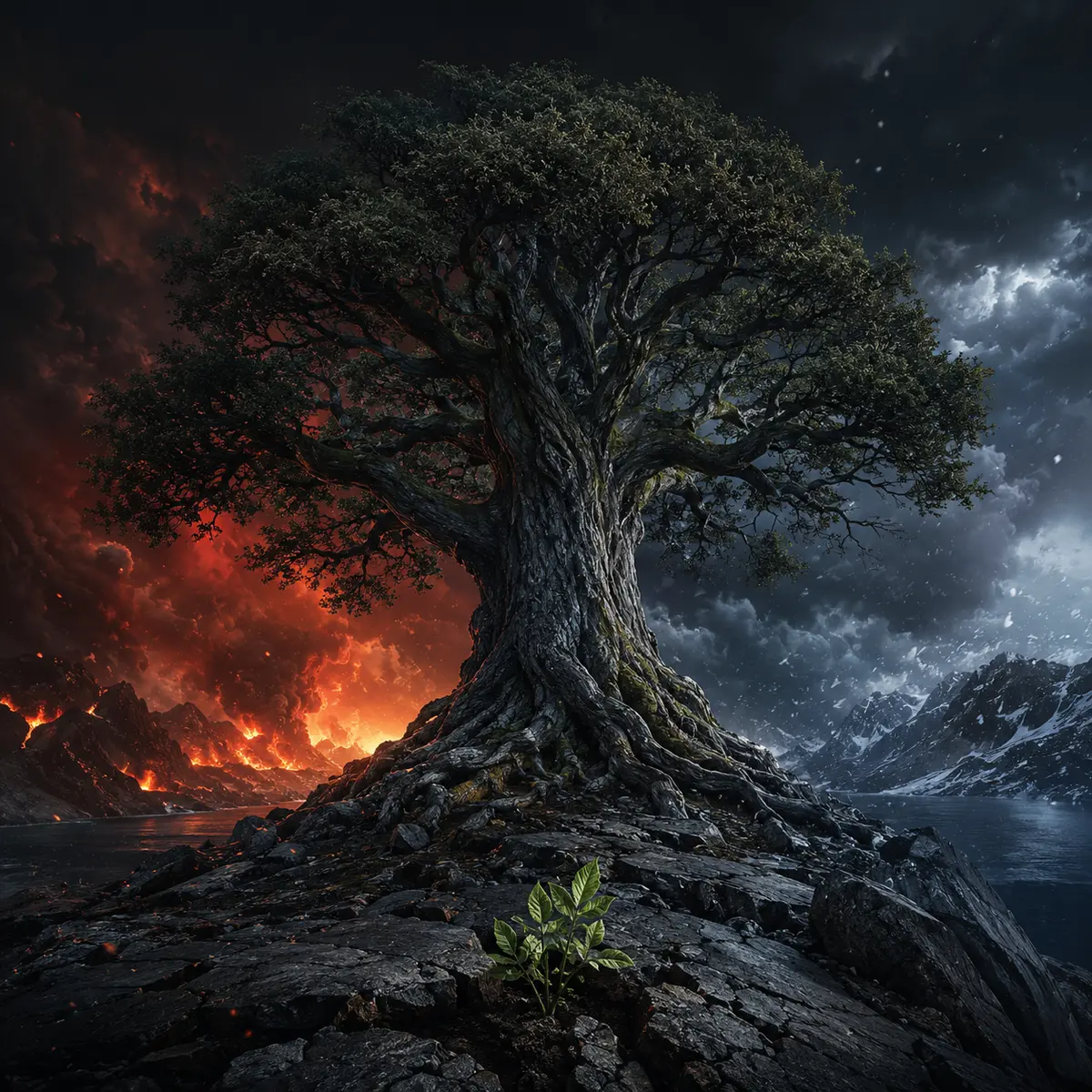
Ragnarök is often reduced to a spectacular final battle. In the Eddic traditions it is larger than warfare: bonds fail, cosmic order collapses, major gods die and the inhabited world is destroyed. Yet the story does not stop there. The earth rises again, fields grow without sowing and life returns.
More Than a Final Battle
Ragnarök is the crisis in which the existing order of gods, humans and cosmic boundaries breaks apart. The word is commonly understood as the fate or doom of the divine powers, although modern English often treats it simply as the end of the world.
The best-known narrative is reconstructed mainly from Völuspá in the Poetic Edda and Snorri Sturluson's Prose Edda. These sources overlap, but they are not identical scene-by-scene accounts.
The myth combines social collapse, monstrous enemies, environmental catastrophe and unavoidable fate. Its meaning lies not only in who fights whom, but in the failure and eventual rebuilding of the entire world order.
Ragnarök is not only the end of a world. It is the passage into the next one.
The Signs Before Ragnarök
Snorri describes Fimbulvetr, a sequence of severe winters with no summer between them. Human relationships collapse as violence spreads and the ordinary rules holding society together fail.
The sun and moon are overtaken, the earth shakes and bonds break. Fenrir and Loki are released, the ship Naglfar moves, and forces associated with giants, the dead and fire advance toward the gods.
Some elements appear differently or with less detail in the poems. The familiar modern timeline is therefore a synthesis, shaped especially by Snorri's effort to organise scattered poetic material into a continuous story.
Gods Who Know Their Fate
A defining feature of Ragnarök is that knowledge does not provide escape. Odin seeks wisdom about the future, and the gods bind dangerous forces, yet their actions delay rather than permanently prevent the crisis.
In the best-known version, Fenrir kills Odin and Víðarr avenges him. Thor defeats Jörmungandr but dies after moving only nine steps from the serpent's venom. Freyr faces Surtr, while Heimdall and Loki kill one another.
The gods are not powerful because they can cancel fate. Their courage is expressed through acting while knowing that victory cannot preserve the present world forever.
Fire, Sea and the Collapse of Order
The imagery of Ragnarök combines several forms of destruction. The world is shaken, the sea rises, the sun darkens and Surtr's fire consumes the earth.
These images should not automatically be read as a factual memory of one volcanic eruption, eclipse or climate event. Scholars can investigate relationships between myth, environment and historical experience, but no single disaster has been proven to explain the complete narrative.
Myth transforms familiar dangers—winter, fire, flood, darkness and social violence—into a cosmic breakdown. It is not a medieval scientific forecast.
The World Rises Again
Völuspá does not finish with permanent emptiness. The seeress describes the earth rising green from the sea, waterfalls flowing and fields producing crops without sowing.
Some gods return or survive, including Víðarr, Váli and the sons of Thor. Baldr and Höðr also appear in the renewed world. The human pair Líf and Lífþrasir survive and become ancestors of future people in Snorri's account.
Renewal does not erase the catastrophe. It gives it a second dimension: systems end, life continues and a new order grows from what remains.
Fate, Renewal and the Problem of a Cycle
Ragnarök is often called a cyclical myth, but the surviving texts do not clearly say that exactly the same events repeat forever. The world is renewed after destruction; that is not automatically the same as an endless identical loop.
The poem preserves both return and change. Old game pieces are found again, surviving gods remember earlier events and a new human future begins.
It is therefore safer to describe Ragnarök as destruction followed by renewal rather than claiming that Norse people believed in a perfectly repeating cosmic cycle.
Sources and the Christian Context
The Codex Regius manuscript containing Völuspá was written in the thirteenth century, and Snorri composed the Prose Edda in Christian Iceland. The traditions may preserve much older oral and poetic material, but they reached us through a medieval literary world.
Parallels with Christian apocalypse and renewal have led to long debate. Christian influence is plausible in parts of the transmission, but it does not follow that the entire Ragnarök tradition was simply copied from Christianity.
The responsible position is to recognise both layers: inherited Norse mythic material and the literate Christian context in which the surviving versions were recorded and organised.
Ragnarök in Modern Culture
Games, films and metal imagery usually emphasise the battle, flames and monsters. These are genuine elements of the myth, but they often remove the quieter ending in which land, food, memory and human life return.
Modern Norse pagan communities may interpret Ragnarök spiritually, ethically or symbolically rather than expecting a literal future battle. Such readings belong to living contemporary religion and should not be presented as one unchanged Viking Age doctrine.
For modern design, the contrast between destruction and renewal offers a deeper identity than violence alone: endurance means facing what cannot be avoided and still carrying life forward.
Summary
Ragnarök brings the collapse of social and cosmic order, the release of destructive forces and the deaths of major gods. It is shaped by fate: even divine knowledge cannot remove what is coming.
But the myth continues after the fire and sea. The earth returns, gods survive or come back, and human life begins again. Ragnarök is therefore both catastrophe and renewal—not simply a Norse word for apocalypse.
Source trail