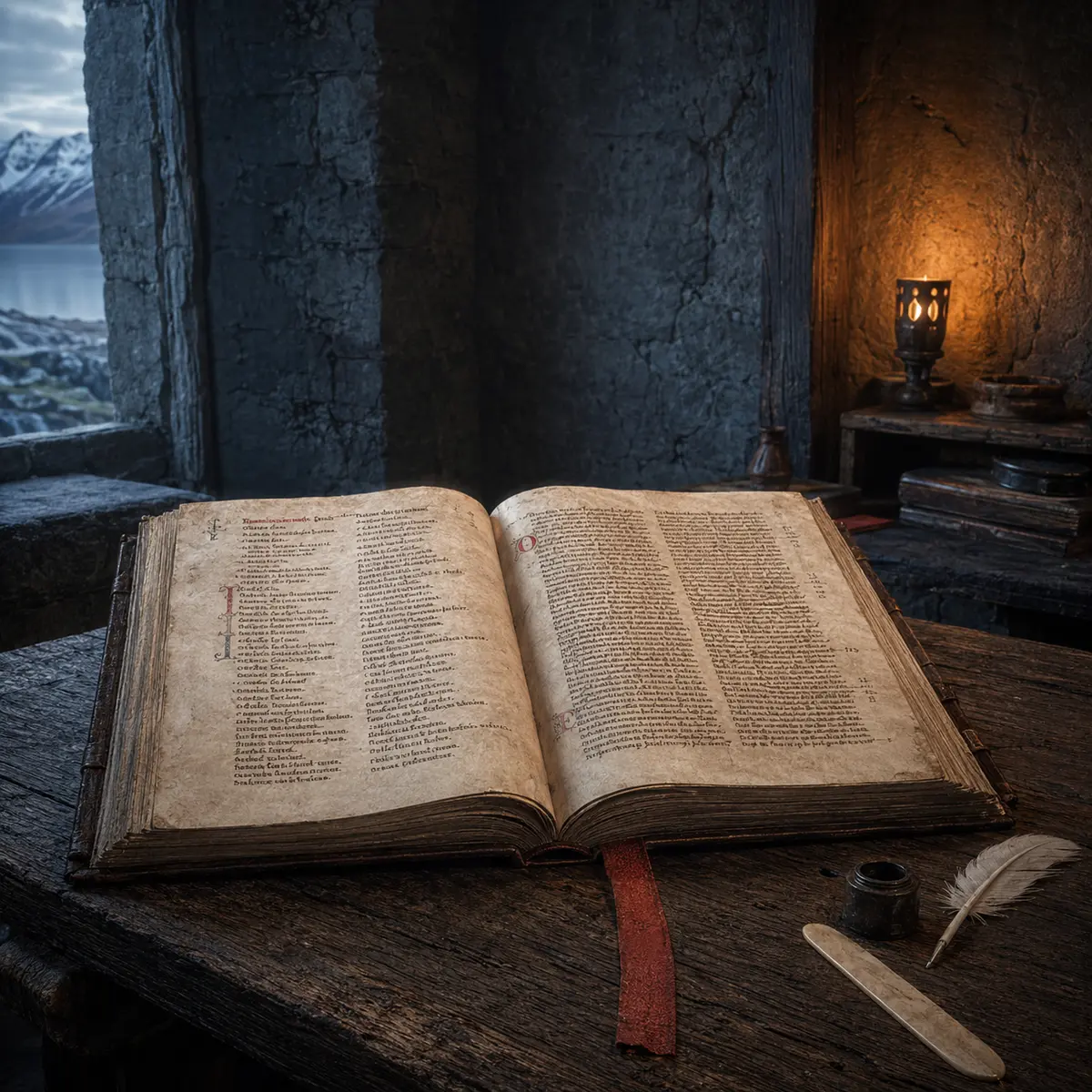
Odin's sacrifice, Thor's journeys, Yggdrasil and Ragnarök are familiar today because medieval Icelanders preserved and organised older traditions. Two works called Eddas are central to that survival—but they are different kinds of source, created for different purposes.
Not One Viking Bible
The Poetic Edda and the Prose Edda are not two versions of one ancient sacred book. They are separate medieval works connected by their preservation and explanation of Old Norse poetry and myth.
Pre-Christian Scandinavian religion had no known universal scripture, central church or institution fixing one official mythology. Stories lived through performance, poetry, ritual, memory and local variation before some were written down.
Calling the Eddas a Viking Bible creates a false impression of doctrine, authorship and date. They are indispensable sources, but they do not contain every tradition believed across Viking Age Scandinavia.
The Eddas preserve traditions. They do not freeze an entire religion into one rulebook.
The Poetic Edda: Anonymous Poems
The Poetic Edda is a modern name for a collection of anonymous Old Norse poems. Its mythological section includes works such as Völuspá, Hávamál, Grímnismál and Þrymskviða; later poems in the manuscript concern legendary heroes including Sigurðr and Brynhildr.
The principal manuscript is GKS 2365 4to, usually called the Codex Regius of the Poetic Edda. It was written around 1270, roughly two centuries after the conventional end of the Viking Age.
The poems themselves can be older than the manuscript and many travelled through oral performance. Their individual dates remain debated, and it is unsafe to assign the entire collection to one moment or one author.
Codex Regius: Survival with Gaps
Codex Regius is not the original manuscript of every poem it contains. It is a thirteenth-century compilation whose scribe copied material already circulating in other forms.
Eight leaves are missing from the heroic section, creating the famous Great Lacuna. Parts of the lost narrative can be compared with later prose works and other witnesses, but the missing pages cannot simply be recreated with certainty.
Not every poem classified today as Eddic appears in Codex Regius. Scholars compare this manuscript with Hauksbók, quotations in Snorri's Edda and other textual witnesses when producing modern editions.
The Prose Edda: Snorri's Handbook
The Prose Edda, also called Snorri's Edda, was composed in Iceland during the early thirteenth century and is traditionally attributed to the poet, historian and politician Snorri Sturluson.
Its purpose was closely connected with poetry. Skaldic verse used old mythic names, narratives and kennings—compressed metaphors that could become difficult to understand as knowledge of pre-Christian tradition faded.
Snorri preserved myths partly to teach readers how the poetic language worked. His book is therefore neither a neutral transcript of oral storytelling nor a devotional manual for practising the old religion.
Inside Snorri's Edda
Gylfaginning presents a connected account of gods, creation, cosmology and Ragnarök through a framed dialogue. It supplies many of the clear narratives used in modern introductions to Norse mythology.
Skáldskaparmál explains the language of poetry, especially heiti and kennings, by connecting expressions with mythic stories. Háttatal demonstrates poetic metres through Snorri's own verses. The work also survives with a Prologue placing pagan tradition inside a Christian learned history.
Because Snorri organises fragmentary traditions into coherent prose, his version can look more systematic than the older poetic evidence actually is.
A Christian Medieval Context
Both Eddas survive from a Christian Icelandic manuscript culture. This does not make every myth a Christian invention, but it affects how the material was selected, explained and written down.
Some poems may preserve pre-Christian language and imagery; other passages may reflect contact with Christian and wider European literary traditions. The layers cannot always be separated cleanly.
A responsible reading avoids both extremes: the Eddas are neither untouched recordings from pagan antiquity nor worthless fabrications created after conversion.
Poetry, Prose and Archaeology
Written sources are compared with picture stones, amulets, graves, place-names and earlier skaldic poetry. Agreement between different evidence can strengthen an interpretation, but it rarely removes every uncertainty.
An image on a stone may resemble a myth known from Snorri without supplying its full name or story. A poem can preserve an old divine name without proving that one ritual was performed throughout Scandinavia.
The strongest historical work begins by asking what kind of evidence we have, when it was created and what its creator was trying to do.
Modern Editions Are Reconstructions Too
The clean text in a modern printed Edda is the result of editorial work. Scholars expand abbreviations, choose between manuscript readings, add punctuation and sometimes reconstruct damaged or missing wording.
Translations add another interpretive layer. A single Old Norse word or kenning can support several English choices, each emphasising a different shade of meaning.
This does not make editions unreliable. It means that precise claims and commercial quotes should identify the poem, stanza, translation and edition whenever possible.
Summary
The Poetic Edda preserves anonymous mythological and heroic poems whose histories often began before their surviving manuscript. The Prose Edda is Snorri's learned guide to myth, poetic vocabulary and metre.
Together they form the central written source base for Norse mythology, but neither is a Viking Age sacred book. Reading them well means respecting oral tradition, medieval Christian transmission, manuscript variation and modern editorial interpretation.
Source trail