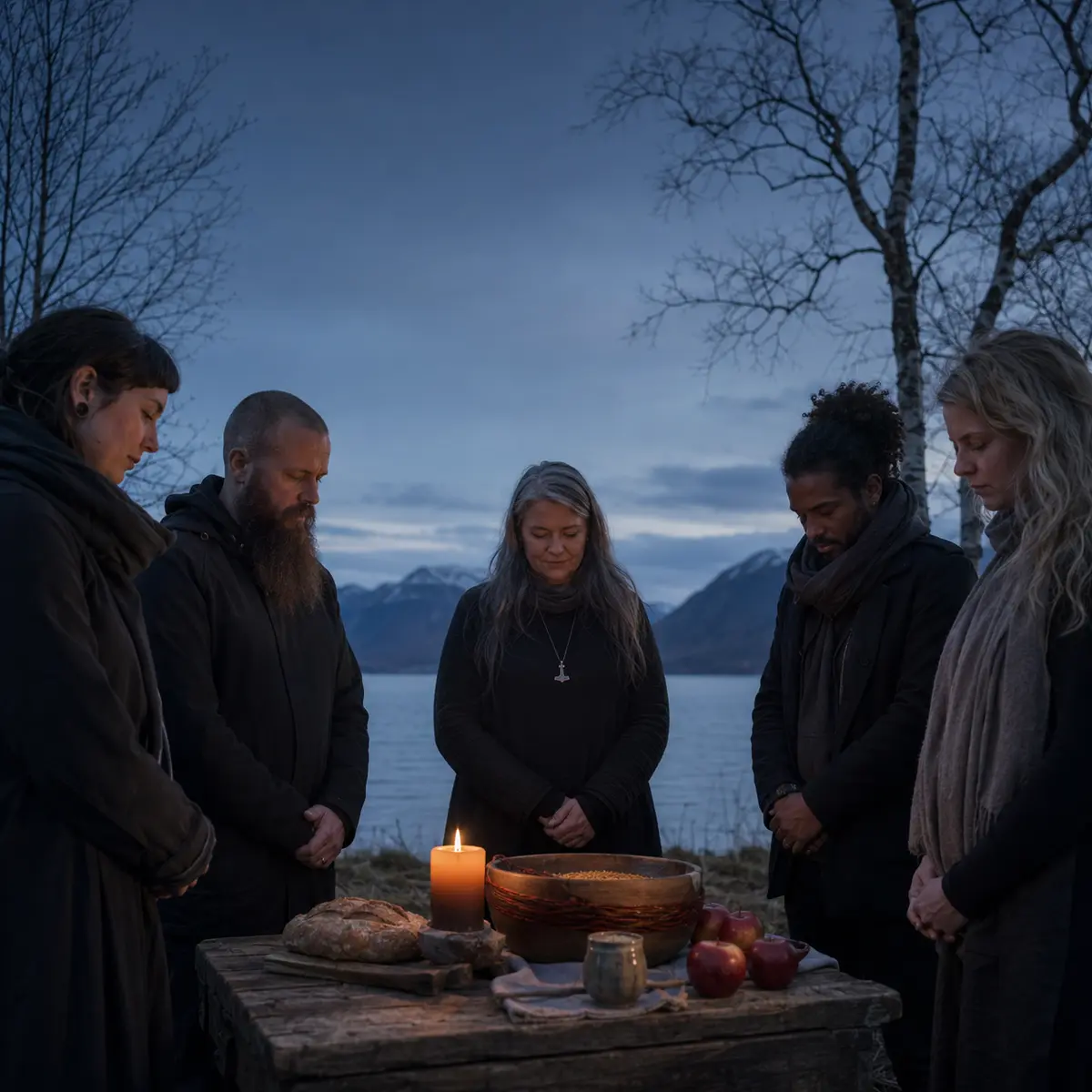
Old Norse religion belongs to the historical past; contemporary Norse Paganism belongs to living people. The two are connected through texts, archaeology, language and cultural memory, but they are not identical. Recognising that distance does not weaken modern practice. It explains how reconstruction works and why present-day Heathens must make choices the surviving sources cannot make for them.
A Modern Religion with Ancient Sources
Heathenry is a modern religious movement inspired by the pre-Christian traditions of northern Europe. Its communities emerged publicly in several countries during the twentieth century, especially from the 1970s onward, after centuries in which the historical religions had ceased to exist as continuous institutions.
There is no securely documented, unbroken line of Viking Age priests, congregations or ritual manuals leading into modern Heathen organisations. Contemporary practitioners instead study fragmentary evidence and build religious lives suited to their own places and times.
That makes Heathenry reconstructed, but not imaginary. Every living tradition is shaped by interpretation. The important distinction is between a historical claim about the Viking Age and a modern religious choice inspired by it.
A LIVING PATH — NOT A FROZEN PAST.
Many Names, No Single Church
Heathenry, Ásatrú, Forn Sed, Germanic Paganism and Norse Paganism overlap, but they are not perfect synonyms. Preferences vary by language, country, historical focus and community identity.
There is no worldwide Heathen authority, shared creed or universal ritual calendar. Some groups focus primarily on Norse gods and Icelandic literature; others work with Anglo-Saxon, continental Germanic or local Scandinavian traditions. Solitary practitioners may organise their religion differently again.
A description of one organisation should therefore not be treated as a definition of every Heathen. Diversity is not a recent corruption of an ancient uniform system; the historical evidence already points to regional variation.
What Reconstruction Can—and Cannot—Do
Reconstruction draws on the Poetic Edda, Snorri's Prose Edda, sagas, law codes, place-names, inscriptions, archaeology and later folklore. These sources were created in different centuries for different purposes, and many were written by Christian authors after conversion.
They can preserve names, stories, ritual vocabulary and traces of practice. They cannot provide a complete handbook for every region of pre-Christian northern Europe. Silence in a source is not proof that a practice never existed, but neither is it permission to label any new invention as ancient.
Responsible reconstruction marks its levels of certainty: documented evidence, scholarly inference, community tradition and personal innovation. The result is strongest when those layers remain visible.
Blót, Community and Relationship
Many modern groups use the Old Norse word blót for a rite centred on offerings and reciprocal relationship with gods, ancestors or local beings. Food or drink may be offered, words spoken and a communal meal shared. Details differ substantially between communities.
Some traditions also practise symbel, a structured round of toasts, boasts or oaths, although the modern form and its historical reconstruction are debated. Seasonal festivals, household observances, weddings and funerals may also be part of contemporary practice.
These rites are not filmed replicas of one Viking Age ceremony. They combine historical vocabulary with modern law, ethics, foodways, family structures and community needs.
Ancestors, Land and Seasonal Time
Modern Norse Paganism is not always focused only on famous gods. Many practitioners honour ancestors, attend to seasonal change and cultivate relationships with the places where they live. Concepts such as landvættir may support this practice, but their application outside the historical Nordic landscape requires interpretation.
Ancestry can mean family memory, cultural inheritance, chosen lineage or responsibility to previous generations. It need not mean biological purity. Living in relationship with land also creates modern obligations: ecological care, respect for Indigenous peoples and attention to the actual history of a place.
The move from medieval Icelandic description to a present-day ritual in Poland, Britain or North America is therefore never automatic. Translation is cultural as well as linguistic.
Modern Ethics Are Modern Responsibilities
The surviving sources do not contain one complete ‘Viking code’ ready to govern a twenty-first-century community. They emerged from hierarchical societies that accepted slavery, feud and legal inequalities that modern practitioners are not obliged to reproduce.
Hospitality, reciprocity, courage and keeping one's word may inspire contemporary ethics, but their meaning must be reconsidered under present conditions. Human rights, gender equality, consent and democratic accountability are modern responsibilities, not problems an Eddic poem can settle by itself.
Calling an ethical decision modern is not an admission of failure. It is an honest recognition that living religion requires judgement rather than historical cosplay.
Inclusion, Exclusion and the Politics of ‘Roots’
Norse imagery has been appropriated by racist and far-right movements, and exclusionary minorities exist within the wider Heathen landscape. Their presence must be confronted directly, but it does not make every Heathen, rune or Mjölnir racist.
Many contemporary organisations explicitly welcome people regardless of race, ethnicity, gender or sexuality and reject the idea that religion is inherited through blood. The Troth, for example, defines its Heathenry through inclusive community and has published formal declarations against bigotry.
Context remains essential. A symbol's meaning depends on its combination with language, political imagery, community statements and behaviour. Neither panic nor denial is a substitute for reading that context carefully.
History Is a Resource, Not a Command
Historical study can challenge fantasy, expose modern inventions and give contemporary practice deeper roots. It cannot decide every ritual gesture or personal belief for people living a thousand years later.
Modern Heathenry becomes more credible when it says where evidence ends and choice begins. A reconstructed offering, an inherited family custom and a newly created devotional practice can all matter, provided they are not presented as the same kind of evidence.
This distinction also helps artists. Contemporary Norse work can carry genuine spiritual meaning without claiming to be an archaeological replica or the secret recovery of an unchanged Viking faith.
Summary
Heathenry and Ásatrú are modern, diverse religions in dialogue with pre-Christian Germanic traditions. They reconstruct from incomplete evidence, adapt practice to modern lives and disagree about theology, ritual and identity.
The historical Old Norse religion is not identical to its contemporary descendants. That distance is where responsible study, ethical choice and creative renewal take place.
THE OLD WAYS LIVE BY CHANGING.
Source trail