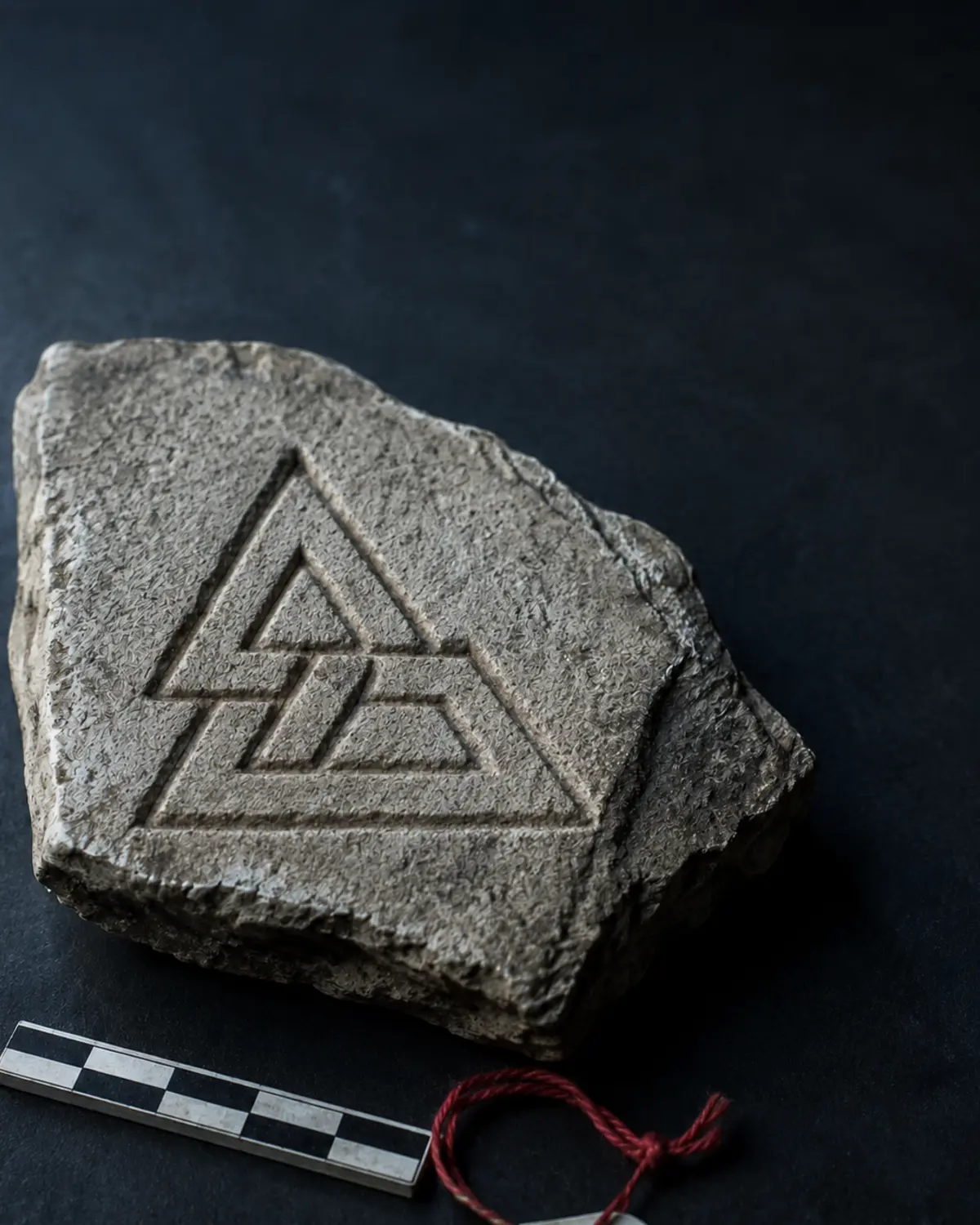
The symbol popularly called the Valknut appears in countless tattoos, pendants and Viking designs. Its archaeological foundation is real, but the familiar name and most precise definitions were created later. The responsible question is not simply “What does the Valknut mean?” It is “What can each surviving object actually support?”
The Motif Is Historical
Related compositions of three triangles occur on early medieval objects from Scandinavia and England. They are not a modern invention retroactively drawn into Viking art.
The forms are not completely uniform. Some examples use three separate interlocking triangles; others are drawn as one continuous trefoil-like line. Placing both under one modern label is useful, but it may conceal differences that mattered to their makers.
No runic inscription functions as a caption saying what the design was called or how every viewer should understand it.
THE OBJECTS ARE REAL. THEIR ORIGINAL EXPLANATION IS MISSING.
The Name “Valknut” Is Modern
The word Valknut is commonly translated as “knot of the slain.” It sounds Old Norse, but it is not recorded as the Viking Age name for the three-triangle motif.
The Gotlandic Picture Stones research catalogue notes that the Scandinavian term is not documented before the early eighteenth century and was used for several knot-like forms in later folk art. Its application to the ancient triangular motif belongs to modern classification.
The name therefore guides interpretation before the evidence has spoken. Calling it “the knot of the slain” can make a connection with death and Odin appear proven when it remains a scholarly proposal.
Where the Three-Triangle Motif Appears
Gotlandic picture stones provide the best-known Scandinavian examples. At Stora Hammars I, the motif appears among complex scenes involving weapons, a hanging figure and actions often interpreted through sacrifice or death. At Tängelgårda and Lillbjärs, related forms occur near riders, horses and processional imagery.
The Oseberg ship burial in Norway also contained carved and woven triangular designs. In England, the eighth- to ninth-century River Nene gold ring carries three incised interlaced triangles on one bezel.
These contexts make the motif historically important, but they do not form a surviving dictionary. A symbol beside a rider or inside a burial can contribute to the scene without having one independent meaning everywhere.
The Odin Interpretation
Many researchers and modern practitioners associate the motif with Odin. The proposal is understandable: several image-stone scenes contain spears, riders, the dead or actions that resemble themes connected with Odin in later texts.
Odin is a god of war, death, knowledge, ecstatic inspiration and the battle-slain. A knot has also been compared with his power to bind and release minds or outcomes.
Yet no inscription beside the triangles says “Odin,” and the surrounding figures can themselves be difficult to identify. The association is plausible contextual interpretation—not a decoded ancient label.
CONNECTED WITH ODIN IS NOT THE SAME AS PROVEN TO MEAN ODIN.
Was It Hrungnir's Heart?
Snorri Sturluson's Skáldskaparmál describes the giant Hrungnir as having a hard stone heart with three pointed corners, resembling a carved design called Hrungnis hjarta—“Hrungnir's heart.”
This passage offers an intriguing comparison with triangular motifs. It does not securely identify every interlaced three-triangle composition as Hrungnir's heart. Snorri wrote in thirteenth-century Iceland, and his brief description does not include a surviving illustration.
The comparison should remain a hypothesis rather than a replacement for the equally uncertain modern name.
The Nine Points Do Not Prove the Nine Worlds
A popular modern explanation assigns the symbol's nine points to the Nine Worlds of Norse cosmology. It creates an elegant design story, but no Viking Age source makes that connection.
As the earlier Yggdrasil lesson showed, surviving texts do not even provide one complete agreed diagram of nine worlds. Counting nine points in a later geometric reconstruction cannot supply the missing evidence.
The nine-world reading can be used as a contemporary artistic interpretation when it is labelled as such.
Modern Use and Appropriation
Today the motif is used in Heathenry, jewellery, tattoos, memorial art, music and commercial Viking imagery. Modern wearers may connect it with Odin, ancestors, courage, mortality or commitment to a spiritual path.
It has also been appropriated in some extremist settings. That does not make every use extremist, but context matters: accompanying slogans, organisations, other symbols and the declared intent of the wearer must be considered together.
Modern religious and personal meanings are genuine present-day meanings. They should not be presented as a universally documented Viking Age code.
A Responsible Design Standard
R3X Studio can describe the shape as an “ancient three-triangle motif commonly called the Valknut today.” This preserves both the archaeological evidence and the uncertainty.
A product can then declare its contemporary layer: an R3X interpretation of connection, mortality, Odin, memory or the Nine Worlds. It should avoid claiming that the exact message was carved into every historical example.
HISTORICAL FORM. MODERN NAME. DECLARED INTERPRETATION.
Summary
The interlaced three-triangle motif is present on genuine early medieval objects, including Gotlandic picture stones and the River Nene ring. Its original name and exact meaning are not preserved.
Connections with Odin, death, binding and Hrungnir's heart remain possible interpretations. The popular nine-world explanation belongs to modern symbolism. Good design does not erase these uncertainties—it makes them part of the story.
THE MOTIF IS OLD. THE CERTAINTY IS NEW.
Source trail
Continue with the evidence
R3X artwork bridge
Elemental Valknut
R3X Studio's elemental treatments are contemporary visual interpretations built on a historical three-triangle form. Fire, ice, storm and Nine-World meanings belong to the studio's New Code—not to one preserved Viking Age explanation.
Explore R3X Studio on Etsy →