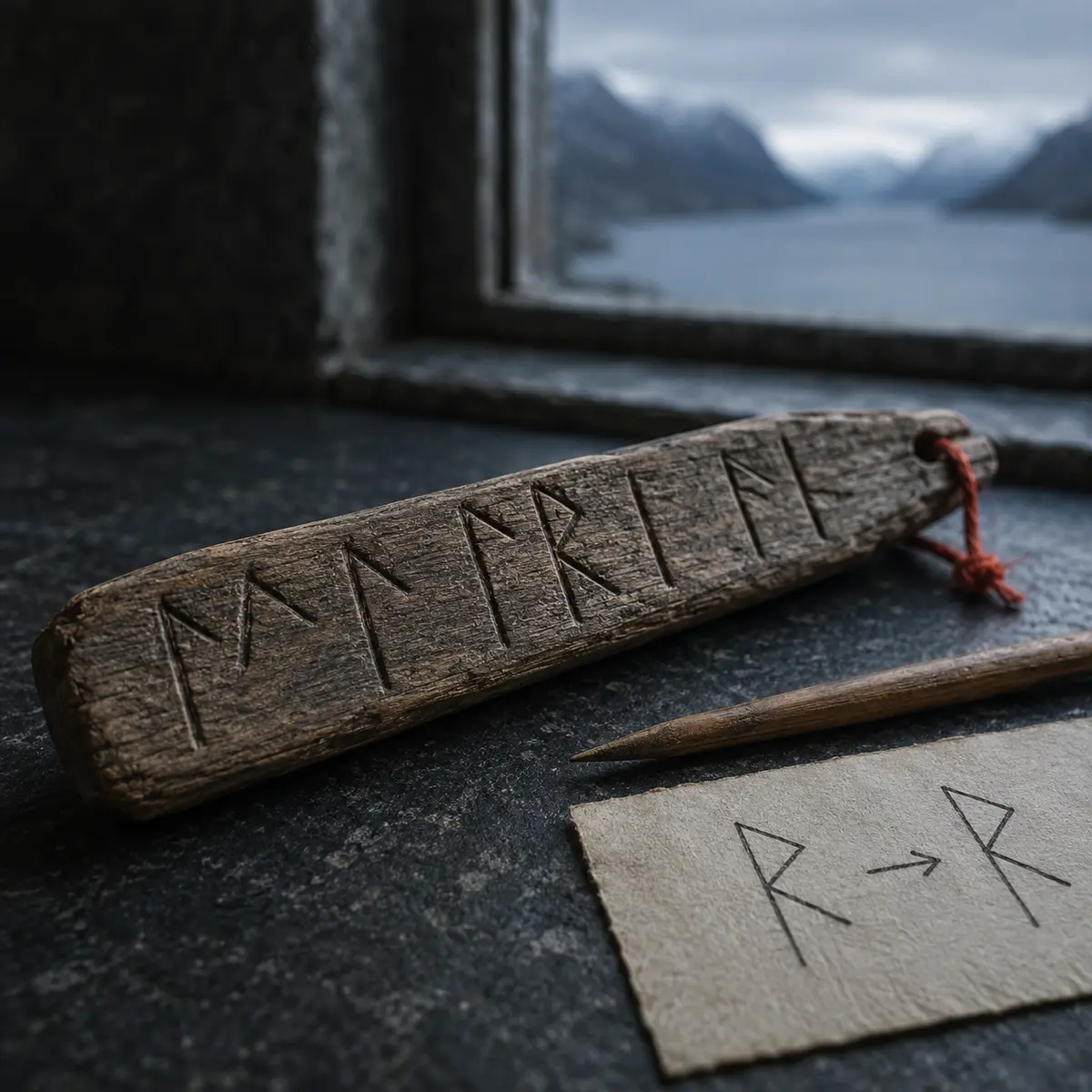
Modern bindrunes are often presented as ancient Norse sigils built by combining the meanings of individual runes. Historical runology describes something more specific: a bindrune is a graphic ligature in which two or more runic characters share part of their form. Some may have been ornamental, emphatic or used in unusual inscriptions, but their joined shape alone does not prove magical purpose.
A Bindrune Is a Ligature
In runology, a bindrune is formed when two or more runic characters are joined graphically. They commonly share a vertical stave, allowing several sound-bearing signs to occupy one compact form.
Most documented examples combine two runes, although combinations of three or more exist. The components still belong to a word or sequence and can usually be transliterated as separate letters.
This makes the ordinary Latin ligatures æ and œ a useful comparison. Joining letters changes their appearance; it does not automatically create a new supernatural symbol.
FIRST READ THE LETTERS. THEN INTERPRET THE FORM.
Bindrunes Did Not Belong to One Period
Runic ligatures occur across a long history of runic writing. They are documented in inscriptions using the Elder Futhark, in Viking Age material written with Younger Futhark, and in the much larger medieval runic tradition.
Their frequency and preferred forms changed by time and region. A complex medieval bindrune should therefore not be copied into a Viking Age design merely because both use runes.
Dating the object and identifying its rune row remain essential. The label ‘Norse’ is too broad to establish that every historical form belongs in the same design system.
Why Did Carvers Join Runes?
A ligature could conserve space, resolve a carving problem, correct or absorb a misplaced letter, or create a visually distinctive form. In some inscriptions it may also provide ornament or emphasis.
The Menota handbook shows bindrunes inside words and even across word boundaries. Its examples demonstrate that the phenomenon belongs to writing practice: the joined components still participate in spelling and grammar.
The precise motive is not always recoverable. A practical explanation may fit one inscription while a decorative choice better explains another. Responsible interpretation begins with the whole text and object.
What Viking Age Examples Can Show
Some Viking Age runestones use joined forms within names, signatures or ornamental arrangements. A shared stave can make a name stand out or help the text fit its carved path.
On other objects, complex groups of signs appear within difficult or possibly protective texts. The rune sheet in the Swedish History Museum preserves one debated example whose opening consists of bindrunes and has received different readings.
That uncertainty matters. One unusual inscription cannot establish a universal rule that every bindrune encoded a spell, a deity or a fixed combination of abstract powers.
Does a Bindrune Prove Magic?
No. The most extensive scholarly survey of runic ligatures concluded that bindrunes as a graphic class carry no inherent phonological, ideographic or magical significance beyond their constituent runes.
A particular inscription may still have a ritual purpose. Evidence would come from its words, object type, placement and archaeological context—not simply from the fact that two rune forms overlap.
Uncertainty is not proof of magic. When a sign is hard to separate or a text is unreadable, ‘unknown’ is more accurate than assigning it a protective meaning by default.
COMPLEX SHAPE IS NOT PROOF OF A SPELL.
Bindrunes, Cipher Runes and Later Magical Signs
Bindrunes combine visible letterforms. Cipher runes conceal or encode letters through another system, such as counting branches. The two techniques may both make a text difficult to read, but they do not work in the same way.
Early modern Icelandic magical signs add another layer. Their complex forms and manuscript traditions belong mainly to a much later period and should not be treated as ordinary Viking Age bindrunes.
A useful catalogue therefore labels each object by technique and date: ligature, cipher, later magical stave or modern graphic symbol. Similar appearance does not guarantee shared origin.
Modern Personal Bindrunes
Today artists and practitioners often select several runes for concepts such as protection, strength or transformation and merge them into one symmetrical emblem. This can be a thoughtful modern act of identity, devotion or design.
It is not the same method as joining consecutive letters in a historical word. The modern designer usually combines symbolic interpretations of rune names, while the historical carver was frequently ligaturing parts of written language.
The distinction does not invalidate contemporary practice. It gives the object an honest description: a modern bindrune inspired by historical runic forms, not a recovered universal Viking sigil.
A MODERN SYMBOL CAN BE MEANINGFUL WITHOUT BEING AN ANCIENT FORMULA.
A Better Standard for Rune Design
For a historically based ligature, begin with a word in the appropriate language and rune row. Identify which adjacent letters can share a stave, preserve reading order and document the source or design logic.
For a personal symbolic bindrune, state the chosen rune set and the contemporary meanings used. Avoid claiming that its exact geometry was carried by Viking warriors unless a dated inscription actually supports that statement.
R3X Studio can make the two modes visually distinct: Historical Ligature for documented writing and New Code Bindrune for contemporary identity art. Clear labels turn source criticism into part of the premium experience.
Summary
Historical bindrunes were joined rune characters. They could save space, solve a carving problem, decorate a text or create emphasis, and their use varied across periods and regions.
Some appeared in ritual contexts, but the ligature itself was not automatically magical. Modern bindrunes often combine symbolic meanings instead of consecutive letters. They are legitimate contemporary creations when presented as modern interpretation.
JOINED LETTERS THEN. DESIGNED MEANING NOW.
Source trail